En o ja, best belangrijk: "Aan personen van verschillend geslacht wordt alleen een 2-persoonskamer toegewezen als er sprake is van een wettig huwelijk." We moeten het namelijk wel FATSOENLIJK houden.
Bijna dagelijks post Ronny Naftaniël van de Nederlandse pro-Israël lobby baarlijke nonsens op Twitter. Vandaag: "90 Palestijnen proberen met geweld het Qalandia checkpoint over te gaan. Ze gooien met stenen. Israelisch leger arresteert 6 stenengooiers"
Naftaniël's bronnen zijn onbetrouwbaar. Protesteren is volgens hem "geweld", en het stenen gooien (heeft hij zelf gezien?) is blijkbaar zo erg dat hij het twee maal in één tweet propt. Dat de zwaar bewapende Israëlische soldaten continue traangasgraten afschieten op de protesteerders, vindt Ronny blijkbaar blijkbaar geen "geweld". Wie weet, misschien vindt hij het wel weer "zelfverdediging", net zoals hij beweerde over de honderden gedode kinderen in Gaza 2008-2009. De man heeft geen enkele moraal.
Het CIDI noemde het beschieten van scholen in Gaza "een tragisch incident", en dat het ook wel meeviel allemaal. Daarna lezen we weer sprookjes over de Israëli's het allemaal ook heel erg vonden, en dat Hamas burgers als schild gebruikt, nee sterker nog, Hamas stuurde hen juist de bombardementen in, nee nog sterker: Gazanen werden gedood door de boobytraps van Hamas.
Hoe zou Naftaniël gereageerd hebben wanneer Gazanen honderden joodse kinderen naar het hiernamaals zouden schieten? Zou hij dan ook uitleggen dat dat "niet buitenproportioneel" is, en de schuld is van het IDF? Nee, natuurlijk niet, want de Naftaniël's humaniteit stopt bij het checkpoint.
Wat er werkelijk in Qalandia aan de hand is:
French activists arrested at West Bank protest (AFP) – 1 hour ago
JERUSALEM — Nine French activists were arrested on Sunday during a pro-Palestinian demonstration at a major Israeli checkpoint in the West Bank, police and protest organisers told AFP.
"Our forces today dispersed protesters who were throwing rocks at us and proceeded to arrest nine people, including some foreigners," Micky Rosenfeld said.
"The protest took place at the Qalandia checkpoint, north of Jerusalem, and the police made arrests after the activists tried to cross the checkpoint," he added.
A spokesman for the French EuroPalestine activist group said nine French citizens were arrested at the demonstration. A Palestinian detained at the protest was later released, he said
On Saturday, another French activist, Layli Ben Saffi, was arrested by the Israeli military during a protest against Israeli settler activity in the West Bank city of Hebron. He was released on Saturday evening.
Some 70 members of the EuroPalestine group have spent the last week in the Palestinian territories on an observer mission, a group spokesman said.
The president of the organisation, Olivia Zemor, was deported last Wednesday "on the recommendation of the security services," after being detained at Ben Gurion upon arrival.
Foto's van Qalandia vandaag (en eerder) over het "geweld" van de "90 Palestijnen" die "stenen gooien":
Israeli policemen scuffle with Palestinian and foreign activists during a protest against Israel's separation barrier at the Qalandia checkpoint between Ramallah and Jerusalem, Sunday, Dec. 26, 2010. Israel says the barrier is necessary for security while Palestinians call it a land grab.
Nog meer "geweld" van de dames.
Gooide iemand daar iets? Ronny, twitteren joh! Israeli soldiers clash with foreign and Palestinian activists during a pro-Palestinian protest at the major Israeli checkpoint of Qalandia, between the West Bank city of Ramallah and Jerusalem, on December 26, 2010 where nine people were arrested including some foreigners.
Later this year, 21-year-old Ephraim Khantsis will pack a couple of suitcases, say good-bye to his mother, leave his home in Brooklyn, and move to Israel. On arrival in Jerusalem he will enroll in a yeshiva, or religious school, that is popular with Americans. After a few months he will make his way north, to a place this young American feels is his true home: the Jewish settlement of Kfar Tapuach.
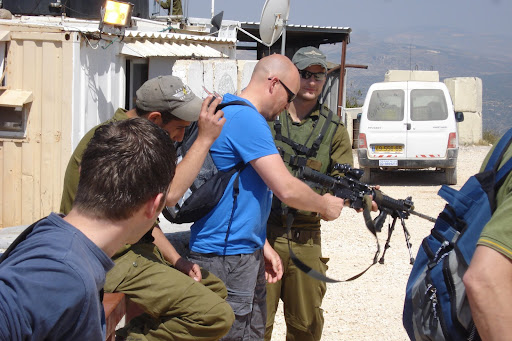
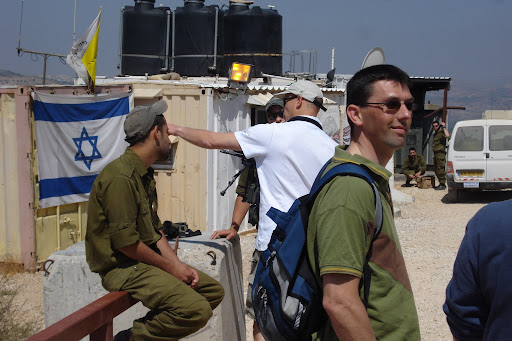
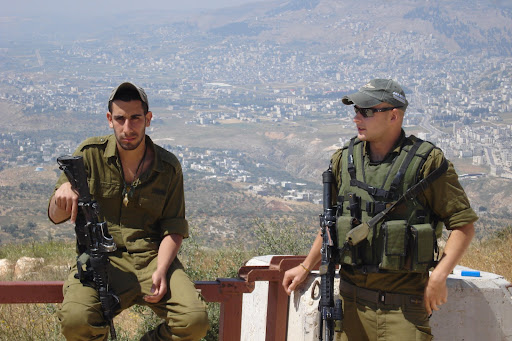
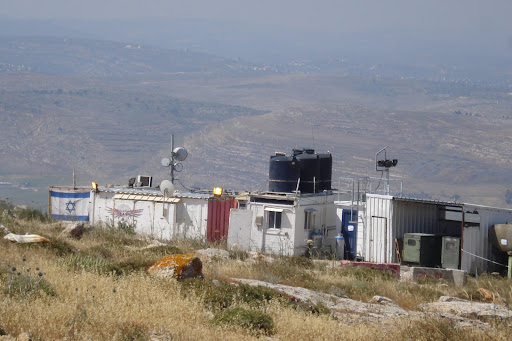
Perched on a hill just off Route 60, the main north-south road in the occupied West Bank, Kfar Tapuach is known as a particularly hard-line community. Home to about 600 people, the settlement has a history of welcoming American immigrants whose beliefs and acts raise alarms among Israeli intelligence agencies, leading them to monitor it as a haven for suspected terrorists.
Khantsis, who is in the process of applying for Israeli citizenship, will fit right in. Like the assassinated Brooklyn-born rabbi Meir Kahane, the man some in Kfar Tapuach consider their spiritual leader, Khantsis believes that all Arabs and Palestinians should be forcibly removed from territory controlled by Israel, including the West Bank.
“It’s the most humane way to solve the situation,” Khantsis—who has just graduated from Stony Brook University, on Long Island, with a degree in computer science—says, sipping a soda in an Israeli-run kosher pizzeria in Bensonhurst, Brooklyn, this past June. He acknowledges that he is advocating ethnic cleansing.
While such a view is unlikely to become mainstream in Israel, there’s a pledge Khantsis makes, one that it’s also possible to hear from Americans already living in settlements, that might be more troubling to Israeli authorities: If the Israeli military comes to remove him from his new home—and many in Israel believe such an event is likely—he will not leave peacefully.
“I would fight against it with all my strength, and I would leave nothing back to try to stop it,” says the slim young man wearing a black yarmulke. He speaks so softly that at times it’s hard to hear him. “If they use violence, then we’re justified doing the same.”
Would that include using a gun?
“Yes,” he says.
Is he absolutely sure that he would use a weapon against Israeli soldiers?
“That’s right. I strongly hope it would never come to that,” he says. But “if they’re already shooting us, I’d have no option. I don’t think the right thing to do is turn the other cheek. It’s not a Jewish thing to do.”
After Israel won the Six-Day War in 1967 and took control of the Gaza Strip and the West Bank—Palestinian areas that had been held by Egypt and Jordan, respectively—religious and right-wing Jews quickly began pushing for the establishment of communities on what they considered land promised them by God. At first the Israeli government refused to let them build on occupied territory, but as the years went by, homes and businesses started popping up.
In May of this year, Secretary of State Hillary Clinton made it clear that the Obama administration would have little tolerance for the growth of existing settlements. After Obama’s position was made public, extremist settlers rapidly erected new buildings and repaired outposts. In one location they built a wooden structure they named an “Obama hut.” Around the same time, an Israeli newspaper reported that the senior Israeli army officer in the West Bank had received threatening letters, apparently from radicals trying to dissuade the military from evicting settlers from their homes.
An unknown number of North Americans have settled in the West Bank and Jerusalem since Israel occupied the territories in 1967 and retain dual citizenship. Middle East historian Juan Cole wrote that an estimated one third of West Bank settlers are "Americans." (Bron: Bingo! U.S. donors fund illegal Jewish settlements)
There are now more than a quarter of a million Jewish settlers living among almost 2.5 million Palestinians in the West Bank—and many of the radicals resisting Obama’s wishes are American. The approximately 100,000 U.S. immigrants in the West Bank and Israel have been influential from the beginning of the movement, and many of them have been among the most extreme of the pioneers: Kahane founded a political party that was deemed racist and banned from the Knesset before he was assassinated in Manhattan in 1990; Brooklyn-born Baruch Goldstein shot dead 29 Palestinians in Hebron in 1994; and a group of settlers in Hebron, whose spokesman is New Jersey–born David Wilder, was involved in a violent confrontation with the Israeli military last year.
While Kahane’s original followers and other American extremists continue to face arrest and monitoring by Israeli security services, it is the young people—many of them, like Ephraim Khantsis, American—in the settler movement who are now the Israeli government’s primary concern. This new generation of hard-liners differs from the previous one in a crucial way—its members are profoundly alienated from the secular Israeli state.
This increasing radicalization is a response to the forced removal of Jews from West Bank settlements that the Israeli government considers obstacles to peace. In August 2005, the government of Ariel Sharon, once the great champion of the settlement movement, evacuated thousands of people from the Gaza Strip. The settlers generally did not use violence against the soldiers and police officers who came to evict them, tearfully pleading with—and even hugging—them instead. But that strategy failed. Some extremist settlers said they would never leave so easily again. True to their word, they put up a fight when the army tried to evacuate a settlement at Amona, in the West Bank, in February 2006—more than 300 people were injured.
Nowadays the talk is that the next evacuation will lead to even more violence. “I can tell you one thing,” says Yedidya Slonim, a 16-year-old Australian immigrant who lives in a sizable cave on a hill in the West Bank that functions as an illegal outpost called Shvut Ami. “What happened over there when the people hugged the policemen—that ain’t going to happen.”
“A lot of kids have got no authority, just them and God out there on the hills,” says Yekutiel Ben Yaakov, 50, formerly of Queens, New York, who now lives in Kfar Tapuach and has provided guard dogs for some of the young extremists who set up illegal hilltop camps.
How far the youth of the West Bank are prepared to go to stay on what much of the world considers occupied land is a question that is increasingly haunting a country surrounded by enemies. In November 2008, Yuval Diskin, the head of Israel’s internal intelligence service, told the Israeli cabinet that future evacuations would involve “a very high willingness among this public to use violence—not just stones but live weapons—in order to prevent or halt a diplomatic process.”
Making peace with Israel’s traditional enemies may have to wait until the country has dealt with the enemy within.
West Bank settlers clashing with Palestinians who were evicted from their Sheikh Jarrah, East Jerusalem, February 15, 2010. (TIME, Muammar Awad/AP)
Aaron Gottlieb is 15 years old, speaks in a rapid-fire American accent, and has yet to have his first shave. He does not look like much of a threat, but he is part of a group that has many in Israel deeply worried: the Hilltop Youth.
Gottlieb grew up in New Rochelle, New York, and immigrated to Israel with his family when he was 9. Whenever he can get away from his yeshiva in the town of Petah Tikva, he spends the night, along with Yedidya Slonim and other teenage boys, at Shvut Ami. Their mission is simple: to establish Jewish homes on as many strategic hilltops as possible throughout the West Bank. According to Peace Now, an Israeli pacifist organization, there are about 100 such outposts. The mainstream settler movement has largely disowned this radical wing and its frequently violent acts.
“I very much believe I’m a threat to my own government,” Gottlieb says. “There will be no giving up.”
Shvut Ami sits close to Route 60, near the hard-line settlement of Qedumim, one of the first to be established in the West Bank. Israeli police have tried numerous times to remove the teenagers—arresting some of them and destroying their temporary structures—but the kids keep coming back. In four months over the winter, they used picks and shovels to dig the cave into the hillside. To get rid of it, police will need to use dynamite. The boys live there among dusty blankets and pillows, a gas heater keeping them warm at night while they study the Torah.
Many saw the strong resistance put up by the Hilltop Youth and others at Amona as a harbinger of battles to come. “When bricks are thrown at the heads of soldiers and police officers, a line has clearly been crossed,” said then acting prime minister Ehud Olmert.
Like most other settlers, Gottlieb doesn’t call the people in the nearby town “Palestinians.” That would imply that there was a country called Palestine. Sometimes they’re “Arabs,” but mostly he calls them “terrorists.” Gottlieb says he’s not afraid. “God’s with me,” he says. “This land has been ours forever.”
Gottlieb’s belief in his right to live in the West Bank despite international condemnation and the laws of his own government is total. There is very little of America left in him. He goes back sometimes to visit his grandmother, who lives on Park Avenue in New York City, but he dislikes what he sees as the sinfulness of the United States.
“How much are you prepared to sacrifice?” I ask.
“For the land of Israel?” He taps his chest where his heart is.
“Your life?”
“Mm-hm,” he says.
The Palestinian town of Jenin lies about 15 miles north on Route 60 from the cave at Shvut Ami. It was at the refugee camp here, in April 2002, that militant leader Zakaria Zubeidi helped direct a brutal nine-day fight against the Israeli army, during which 23 Israeli soldiers and up to 56 Palestinians, including some civilians, died. Zubeidi survived, escaped capture, and spent the next five years on the lam, avoiding Israeli attempts to assassinate him—he was shot 11 times. In 2007, he and 178 members of the Palestinian political party Fatah, including members of his militia, the Al-Aqsa Martyrs’ Brigade, were granted amnesty by the Israeli government as part of a deal intended to strengthen Fatah. Zubeidi committed himself to working for peace.
But given the recent rise in settler violence, Zubeidi, 33, has begun to lose faith in the possibility of avoiding more bloodshed.
“The next war is with the settlers,” he says, sitting in a room at Jenin’s Freedom Theatre complex this past January. He works at the theater, which was founded in memory of an Israeli woman in order to provide a creative outlet for young Palestinians. “I feel it will be very soon. I would not give it more than a year.”
Zubeidi’s body bears the marks of his experiences during the second Intifada. His face and eyes are scarred from a bomb that blew up as he was handling it. It gives him the look of a crudely tattooed Maori warrior.
I ask him if he and Jenin’s other militants are making specific preparations for war with the settlers.
“Of course we are preparing,” he says. “It will be dependent on individuals—to bomb themselves [as suicide bombers]. And some small guns. If the guns are not available and explosives are not available, we have experience using stones.”
During the six years of the first Intifada, Palestinian protesters, many of them young boys, would line up against Israeli soldiers and tanks, raining stones on the well-armed troops.
“I don’t fight in the shadows,” Zubeidi says. “I am in the right. They are taking my freedom. They are oppressing me. They are taking our land. We, the Palestinian people, are fighting for our freedom.”
Since I met Zubeidi, that fight has quietly but brutally intensified, and there have been several violent attacks on settlers in the West Bank. On April 2, a Palestinian was accused of using an ax to kill a 13-year-old boy in the settlement of Bat Ayin. A 7-year-old boy, whose father has been in prison for seven years for planning to bomb a Palestinian girls’ school, was also injured.
Security sources told the Israeli newspaper Ha’aretz that they feared Jewish extremists would seek revenge for the attacks. In a vicious cycle of violence that appears to be quickening, radicals on one side are breeding radicals on the other.
Yehuda Goldberg was 16 years old when Israeli intelligence agents came for him. “They surrounded the house and knocked on the door—because they don’t want you to jump out of the window,” says Goldberg, 20, who has a pensive stare and wears the large yarmulke of the youth movement. “It was four or five in the morning. They came also four or five into the house.”
The Israeli officers, from the Shin Bet—Israel’s FBI—searched Goldberg’s bedroom at his family’s house in Kfar Tapuach. They found ammunition, explosives, and knives. He was given a suspended sentence and community service. Goldberg’s father, Lenny—who emigrated from New York City in 1985—is proud of his son. “He was going hand-to-hand combat with soldiers,” he says. “Our generation used to give cups of coffee to soldiers. The police found weapons in his room.”
Goldberg doesn’t want to reveal what he intended to do with the ammunition and weapons. “It’s not weird to have such things in our area,” he says. “Legally, it’s not allowed. But every kid can get ammunition.”
Soon after that arrest, the Shin Bet came to get Goldberg again, accusing him of involvement with a 19-year-old friend who, while awol from the Israeli army, had killed four Israeli Arabs and wounded nearly two dozen with his army-issue M-16 rifle.
The Shin Bet “had information that he was my friend,” Goldberg explains, sitting on a plastic garden chair outside his home while his mother prepares Shabbat dinner. “They arrested me and two other kids. They held me in a chamber for four days, with the light always on. I don’t have bathroom. They close my eyes with black glasses, put me in a chair with my hands behind my back.”
Eventually the Shin Bet released Goldberg and he received a letter saying the case was closed.
Lenny and his wife and their eight children seem to be a welcoming, loving family. Lenny rents out inflatable castles and swimming pools in the summer months. It’s quite a change from his life in New York, where he worked at J. Walter Thompson, a major advertising agency. His children don’t bear much resemblance to the American kid Lenny once was. “They have more chutzpah. They’re more brazen,” he says.
When I meet the Goldberg family in January, Israel’s war against Hamas in Gaza is reaching its end, and Lenny—who is not legally permitted to carry a weapon after a mid-nineties crackdown on Kahane supporters—is frustrated with the military’s strategy, which involves sending soldiers into Gaza. Like many other hard-line settlers, Lenny is not hesitant to express views that most Israelis would consider abhorrent.
“I want them to bomb all of Gaza, even if they kill all the civilians,” Lenny says. “You have to firebomb all of Gaza and not let one Jew get hurt.”
“We can erase them in no time,” Yehuda says of the Palestinians. “But the government won’t let us do it.”
“How does it feel to meet a Jewish terrorist?” asks Yekutiel Ben Yaakov, the guard-dog trainer, laughing, when we meet at a café in the large settlement of Ariel.
“We’re heading toward a situation where in all likelihood there will be bloodshed between Jews,” he says. “I say this with a heavy heart.”
Would this mean settlers shooting at Israeli soldiers?
“I think we’ll see more innovative forms of Jewish resistance,” says Ben Yaakov, who is friends with Ephraim Khantsis and encouraged the young Brooklyn student to move to Kfar Tapuach. “We may see guys that themselves were colonels in the Israeli army or engineers helping the kids create rockets to shoot into Arab villages.”
The point of attacking Palestinians at a time when Israeli soldiers are coming to expel Jews from settlements would be, Ben Yaakov says, to distract and divert the Israeli army and to “change the balance”—to alter the dynamic of the conflict. That would also reduce the chances, he says, of Jews’ killing Jews.
In recent months, this strategy has been adopted by radical settlers around the West Bank. They call it the “Price Tag” campaign: The price for the Israeli government will be high. So far, settlers have blocked roads, attacked Palestinians with guns—during my visit a settler shot dead a Palestinian who was allegedly throwing stones at his car—and other weapons, daubed graffiti on at least one mosque, and battled soldiers by hand and with stones.
Pride of the nation: the Israeli bulldozer.
What Ben Yaakov sees happening is a step up from that kind of resistance.
It would include planting bombs in Palestinian villages. The Dome of the Rock, one of Islam’s holiest sites, might also be a target for Jewish terrorists, as it was in the early 1980s for a group named the Jewish Underground.
There could, perhaps, be no more provocative action for extremist settlers to take than an attack on the Dome of the Rock and the Al-Aqsa mosque, which sit in the old city of Jerusalem, on top of the holiest site in Judaism, the Temple Mount.
Back in the Brooklyn pizzeria, when talk turns to the Temple Mount, Khantsis’ conviction is resolute. “I think it’s one of the greatest insults to put their place on our holy site,” he says. “I think the mosques should be removed. At best they should be peacefully removed and built elsewhere.”
The other option, he says, is that they should be “violently disassembled.”
That is a nightmare scenario for the Israeli government—an act of destruction that would make all-out war almost inevitable.
And it’s a nightmare that has roots that stretch all the way from the hilltops of the West Bank to the quiet streets of the United States.
(vervolg) In Umm el-Fahm zette Israël vandaag haar Darth Vader leger in tegen protesterende Palestijnse Israëli's, en om een mars van joodse fascisten door de Arabische stad te beschermen.
UPDATE In tegenstelling tot eerdere berichten over de "provocaties" van de "stenengooiende" Palestijnen, waar de Israëlische politie op "reageerde", zoals we voorspelbaar in Elsevier kunnen lezen, schreven kranten als Yediot Ahronot en de Jerusalem Post dat de politie al begon met het afschieten van stun grenades op de protesteerders nog voordat de joodse extremisten gearriveerd waren, "to disperse the crowd" om ruimte te maken voor de extremisten.
Israeli undercover policemen detain Israeli-Arab protestors during clashes in Umm El-Fahm, Israel, Wednesday, Oct. 27, 2010
Israeli Arabs run from tear gas and stun grenades during clashes with Israeli riot police, not seen, in the northern Israeli town of Umm el-Fahm, Wednesday, Oct. 27, 2010.
A Jewish extremist shouts slogans towards Israeli Arabs, not seen, in the northern Arab Israeli town of Umm el-Fahm, Israel, Wednesday, Oct. 27, 2010.
Aanhangers van de Amerikaanse rabbijn Meir Kahane, oprichter van de Jewish Defense League (JDL), en van de in 1994 door Israël wegens racisme verboden Kach partij, hebben gisteren gemeld dat ze een eventuele Palestijnse staat van de kaart willen vegen.
Het 'Kahanisme' wordt over het algemeen, ook in Israël zelf, gezien als de Israëlische variant op het fascisme. De hypocrisie is groot omdat zijn aanhangers gewoon onder andere partijnamen in het Israëlische parlement, en nu ook in de regering, zitten. Onze hypocrisie is het ook, omdat wij democratische Westerlingen Israël desondanks blijven betitelen als "de enige democratie in het Midden-Oosten".
De Jewish Defense League was in 1985 volgens de FBI "the second most active terrorist group" in de VS, verantwoordelijk voor 37 aanslagen tussen 1977 en 1984 (Orange County Register, Nov. 19, 1985).
Jewish Defense League youth group at a midtown Manhattan demonstration on January 19, 1975.
De JDL gebruikt de holocaust als inspiratiebron.
De terroristische beweging steunt Geert Wilders.
Zoals gewoonlijk worden berichten over joods racisme door de Nederlandse pers verzwegen, omdat het niet past in het propagandaplaatje van het democratische en vredelievende Israël.
Momenteel neemt de spanning toe in de stad Umm el-Fahm, gelegen in Israël, maar vrijwel uitsluitend bevolkt door Arabische Israëli's. Israël heeft de stad volgezet met honderden politieagenten nadat het Israëlische hooggerechtshof een mars van de fascisten door de stad heeft goedgekeurd. Zoals gewoonlijk reageert de Israëlische politie met geweld op Palestijnse demonstranten en stenengooiers. In werkelijkheid staan ze daar om de fascisten en hun 'democratische recht' om te demonstreren te beschermen. Nadat de fascisten zich terug hadden getrokken in hun bussen, bestormde de Israëlische politie vanmorgen de Palestijnse demonstranten.
De joodse fascisten hebben gisteren te kennen gegeven een eventuele Palestijnse staat van de kaart te vegen. Ik citeer uit de rechtse Israëlische krant Yediot Ahronot:
During memorial service on 20th anniversary of Kach leader's death, Rabbi Yisrael Ariel says, 'If Ishmael state is established - we will destroy it. Suspected 'Jewish terrorist' Haim Pearlman also participates. His wife declares: 'Kahane' is not a dirty word
Hundreds of Land of Israel Movement activists and supporters of the radical movement Kach held a memorial service on Tuesday to mark 20 years since Rabbi Meir Kahane's assassination.
Kach activist Haim Pearlman, currently under house arrest after his suspected killing of four Arabs in the 1990s, was also among the participants. The wife of the 'Jewish terrorist,' Keren Pearlman, told Ynet: "Today everybody knows that 'Kahane' is not a dirty word."
The assembly was held at the Ramada Renaissance Hotel in Jerusalem, where shirts, books and other items were sold to the crowd. Speeches of the late Kahane were screened as well, while protestors went wild, clapping every time he said "Arabs out."
The founder of the Temple Institute, Rabbi Yisrael Ariel, said during the assembly: "Leaders who have ruined our country always tell us that no one can teach them how to love Israel. But this love they are referring to makes them establish an Ishmael state in Israel. If, G-d forbid, an Ishmael state will be built, we will destroy it." The crowd kept cheering him on enthusiastically.
Foto's uit Umm el-Fahm van een protest tegen eenzelde mars in maart 2009, waarover de rechter toen nog besloot dat die alleen in de buitenwijken gehouden mocht worden. Toen werden er meer dan 2500 politieagenten ingezet (onderschriften: BBC News):
Israeli-Arab protesters have clashed with police as Jewish-Israeli right-wingers held a march in the majority-Arab town of Umm al-Fahm in northern Israel.
Police declared an Israeli-Arab counter-demonstration illegal and ordered the protesters to disperse.
Police used stun grenades and tear gas to break up the crowds of hundreds of Israeli-Arab protesters.
Israeli-Arabs hit back by throwing stones at police, as the demonstration descended into violence.
The trouble began during the march of about 100 far-right Israeli-Jewish activists through Umm al-Fahm.
About 2,500 police were deployed to protect the Jewish marchers, whom after several postponements the High Court allowed to march on the outskirts of Umm al-Fahm, but not in the centre.
One of the leaders of the march was Baruch Marzel, who led the anti-Arab Kach party that was banned in Israel in 1994.
Israeli-Arabs make up about a fifth of Israel's population and hold full Israeli citizenship, but face widely-documented discrimination.
Portret van de situatie in Umm el-Fahm, de joodse fascisten en ook de 'loyalty oath' (The Guardian, februari 2009):
Op de sociaalnetwerksite Facebook zijn nieuwe foto's opgedoken van weinig reglementaire praktijken van Israëlische soldaten ten opzichte van Palestijnen. Dat meldt de krant Haaretz. Er is te zien wat militairen uithaalden in woningen van Palestijnen, wellicht tijdens het bloedige offensief tegen Gaza rond de jaarwende 2008-2009. Geblinddoekt De ngo Breaking the Silence postte onder meer een foto waarop te zien is hoe op een geblinddoekte Palestijn, met de handen op de rug gebonden, een geweer wordt gericht en die bij de keel wordt gegrepen. Op een ander afbeelding zit een soldaat gehurkt in de keuken waar twee gesluierde vrouwen aan het koken zijn. Ook is te zien hoe een militair op kinderspeelgoed zit en hoe één met een verfbus een Davidster op de muur spuit met het in het Hebreeuws gestelde opschrift "tot binnenkort".
Dansen Drie weken geleden dook een video op van soldaten die dansen rond een gevangen genomen Palestijnse vrouw en ongeveer twee maanden na foto's van een lachende soldate naast geblinddoekte en geboeide Palestijnse gevangenen. (HLN.be)
"Tot binnenkort"
Israëlische soldaten pesten Palestijnen
JERUZALEM - Een groep Israëlische reservisten heeft maandag nieuwe foto's vrijgegeven waarop te zien is hoe Israëlische militairen Palestijnen mishandelen.
Op een van de foto's is te zien hoe een militair zijn geweer tegen het hoofd van een geblinddoekte Palestijnse man houdt. Een andere foto toont een soldaat die op de muur van een woning in Gaza in het Hebreeuws 'Ben zo terug' spuit. De groep reservisten, Breaking the Silence genaamd, is kritisch over de wijze waarop Israëlische militairen Palestijnen behandelen en zei maandag dat ze de foto's publiceerde om de bewering van het leger dat ongepast gedrag van militairen ongebruikelijk is, te weerleggen.
De vrijgegeven foto's vertonen gelijkenis met andere foto's die de afgelopen maanden in de openbaarheid zijn verschenen. Zo was er het beeld van een vrouwelijke soldaat die naast gevangenen poseerde. Twee weken geleden verscheen dan weer een video waarop te zien is hoe een militair een rondedansje doet rond een Palestijnse gevangene.
Het Israëlische leger zegt op de hoogte te zijn van de foto's, maar heeft geen direct commentaar. (Nieuwsblad.be)



 Bijna dagelijks post Ronny Naftaniël van de Nederlandse pro-Israël lobby baarlijke nonsens op Twitter. Vandaag: "90 Palestijnen proberen met geweld het Qalandia checkpoint over te gaan. Ze gooien met stenen. Israelisch leger arresteert 6 stenengooiers"


 “It’s the most humane way to solve the situation,” Khantsis—who has just graduated from Stony Brook University, on Long Island, with a degree in computer science—says, sipping a soda in an Israeli-run kosher pizzeria in Bensonhurst, Brooklyn, this past June. He acknowledges that he is advocating ethnic cleansing.


 (vervolg) In Umm el-Fahm zette Israël vandaag haar Darth Vader leger in tegen protesterende Palestijnse Israëli's, en om een mars van joodse fascisten door de Arabische stad te beschermen.


 Aanhangers van de Amerikaanse rabbijn Meir Kahane, oprichter van de Jewish Defense League (JDL), en van de in 1994 door Israël wegens racisme verboden Kach partij, hebben gisteren gemeld dat ze een eventuele Palestijnse staat van de kaart willen vegen.


 Verzwegen in de Nederlandse nieuwsmedia.


