Showing posts with label nederzettingen. Show all posts

9 January 2011

Meer dan 150 Israëlische wetenschappers boycotten universiteit in nederzetting Ariel

JERUZALEM - Meer dan 150 Israëlische wetenschappers hebben een petitie ondertekend waarin wordt opgeroepen tot een boycot van de universiteit in de nederzetting Ariel op de bezette Westelijke Jordaanoever. Dat heeft Ron Naaman van het Weizmann Instituut voor de Wetenschap zondag voor de Israëlische publieke radio gezegd.

Ariel is een van de grootste Israëlische nederzettingen op de Westelijke Jordaanoever. Er wonen ongeveer 18.000 kolonisten. De universiteit heeft ongeveer 8500 studenten. „Wij weigeren mee te doen aan een academische activiteit in Ariel, een illegale nederzetting die bedoeld is om te voorkomen dat de Palestijnen hun onafhankelijke staat stichten”, zei Naaman. Hij meent dat de activiteiten van de kolonisten Israël schaden.

De Israëlische minister van Onderwijs, Gideon Saar, heeft de oproep veroordeeld. (Telegraaf)


"As a demonstratively Zionist institution, the University Center has two key requirements: every student must study one course per semester on some aspect of Judaism, Jewish heritage or Land of Israel studies, and the Israeli flag must be displayed in every classroom, laboratory and auditorium on campus." (ariel.ac.il)

7 January 2011

Bezettingstoerisme weer op Vakantiebeurs

Op de Vakantiebeurs zijn weer diverse reisbureau's aanwezig die de comsument misleiden. Het gaat om de zogenaamde Israëlreizen, waarin ook bezoeken worden gebracht aan de bezette Westelijke Jordaanoever en de bezette Golanhoogte, en zelfs naar de nederzettingen. Maar volgens die reisbureaus liggen die locaties vrijwel allemaal "in Israël".

'Israel Wonders'

Organisatie: Israelisch Nationaal Bureau voor Toerisme (stand 08.D088)
Voorheen opererend onder de naam GoIsrael, en sinds kort heet het bureau Israel Wonders.

Vakantiebeurs: St. George klooster in de Judea woestijn toegankelijk voor toeristen
"In de Israëlische Judea woestijn ligt het St. George klooster, beter bekend als het St. George Monastery."

Het Israelisch Nationaal Bureau voor Toerisme trekt zich blijkbaar niets aan van de uitspraak van de Reclame Code Commisie. De Judea woestijn is namelijk helemaal niet "Israëlisch", maar ligt tussen Bethlehem en de Dode Zee, dus op de bezette Westelijke Jordaanoever. Het klooster ligt in het Palestijnse dorp al-Khader (St. George).

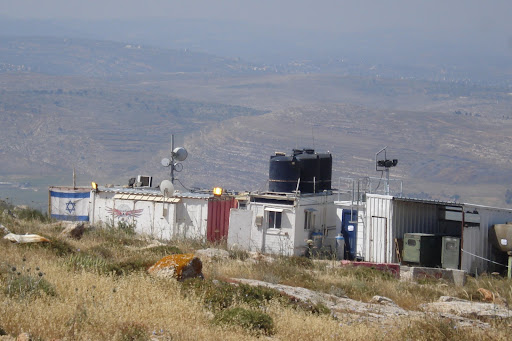
Vlakbij dit dorp ligt de joodse nederzetting Efrat, wiens militante kolonisten o.a. Palestijnse boomgaarden en waterbronnen vernielen. In 2008 hebben ze de 700 jaar oude moskee Al-Hamadiyya in al-Khader in de as gelegd. Toen de tweede intifada uitbrak werden de inwoners van al-Khader zo vaak en zo lang gedwongen thuis te blijven middels de door Israël ingestelde spertijden, dat ze hun land niet meer konden bewerken. Daar maakten joodse kolonisten, die geen spertijd opgelegd kregen, gebruik van door land te stelen en outposts neer te zetten, zoals: "The larger petition against the outpost, which has 17 permanent homes and 15 caravans, was filed by eight Palestinian farmers from the village of al-Khader, together with Peace Now." (augustus 2009)


Links de officiële landkaart van Israël, rechts de versie van het Bureau voor Toerisme - "Israel Wonders"... welke bezetting?


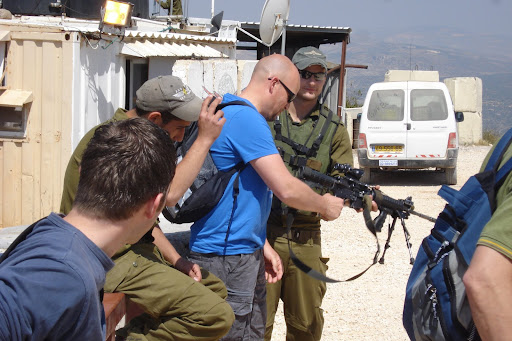
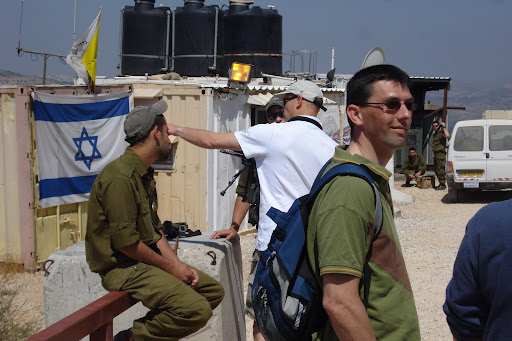
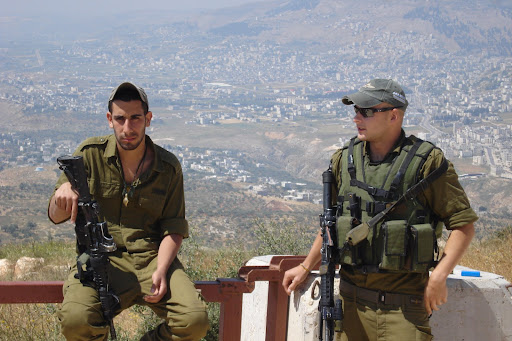
Tijdens de jaarlijkse festiviteiten rond de oprichting van de staat Israël, toont het IDF traditioneel haar hardware. Deze rij machinegeweren werd opgesteld voor de kolonisten van Efrat.

"Op verzoek van de Grieks Orthodoxe aartsvader besloot het Israëlische Ministerie van Toerisme in samenwerking met het Ministerie van Transport de toegangsweg opnieuw aan te leggen. De nieuwe toegangsweg is vanaf 1 december geopend voor toeristen."

Aldus het Israëlische Bureau voor Toerisme, dat natuurlijk niet vermeldt dat Israël met de aanleg van die weg weer meer land van de Palestijnen hebben ingepikt, en dat de protesten van de landeigenaren zoals gewoonlijk weer onderin de prullenbak verdwenen. Het dorp al-Khader wordt bedreigd met complete insluiting door de Israëlische Muur, waardoor het 75% van haar landbouwgrond zal kwijtraken.

Eerlijke reizen naar Israël en de Palestijnse gebieden

Wilt u eerlijk reizen, zodat uw euro's niet worden uitgegeven aan illegale nederzettingen, bezetting en het terroriseren van de lokale bevolking:

Van 11 tot 16 januari presenteren touroperators en reisbureaus hun nieuwe reizen en vakantiebrochures op de Vakantiebeurs in de Jaarbeurs in Utrecht. Dit jaar zal ook de Olijfbomencampagne aanwezig zijn om alternatieve reizen naar Israël en de Palestijnse gebieden te promoten. De stand van de Olijfbomencampagne is te vinden op de Wereldhulpmarkt in Hal 2. Er zullen Palestijnse olijfproducten verkocht worden, verschillende toeristische gidsen, er is informatie van verschillende reisorganisaties in Israël en de Palestijnse gebieden èn de nieuwe promotiefilm van de Olijfbomencampagne zal worden vertoond. Natuurlijk maken wij ook promotie voor onze eigen olijfpluk- en plantreizen!
 
De publieksdagen zijn van 12 t/m 16 januari, dagelijks van 10.00 tot 18.00 uur en op vrijdag tot 22.00 uur

27 December 2010

Fotoverslag bezettingstoerisme van Christenen voor Israël 2009

Bezettingstoerisme onder de bezielende leiding van Henk Binnendijk.


(bron)

En o ja, best belangrijk: "Aan personen van verschillend geslacht wordt alleen een 2-persoonskamer toegewezen als er sprake is van een wettig huwelijk." We moeten het namelijk wel FATSOENLIJK houden.

23 December 2010

Schapen levend verbranden voor Eretz Yisrael


At approximately 12:00 on Saturday, 18 December 2010, a number of Israeli settlers from "Itamar" settlement, southeast of Nablus, attacked Sameer Mohammed Bani Fadel, while he was grazing animals in the east of 'Aqraba village. The shepherd was forced to flee from the area leaving his cattle. The settlers gathered sheep in one place and set fire around them. As a result, 12 sheep were killed, and 7 others sustained serious burns.


November 26, 2010 - Itamar was happy to host a group from NY, NJ, and Maryland that came on a tour with Eve Harrow and the One Israel Fund. They were very moved and inspired by the beautiful community of Itamar.

21 December 2010

Wikileaks: Barak had "geheime overeenkomst" met VS over uitbreiding nederzettingen

De meest verzwegen cable tot nu toe. Enkele dagen na Obama's speech in Cairo, waarin hij onverbloemd een bouwstop voor de joodse nederzettingen eiste, stuurde de Amerikaanse ambassade een geheime cable naar Washington, waarin vermeld wordt dat minister van Defensie Ehud Barak op 15 juni 2009 in een bijeenkomst met Franse regeringsambtenaren meldde dat Israël een "geheime overeenkomst" had met de Amerikaanse regering om "de natuurlijke groei" van de nederzettingen op de Westelijke Jordaanoever te continueren.

Wat president Barack Obama in Cairo zei over de nederzettingen laat niets aan fantasie over:

Israelis must acknowledge that just as Israel's right to exist cannot be denied, neither can Palestine's. The United States does not accept the legitimacy of continued Israeli settlements. This construction violates previous agreements and undermines efforts to achieve peace. It is time for these settlements to stop.

Besproken cable werd afgelopen zondag, 19 december 2010 vrijgegeven. Hoe reageert Nederland op deze belangrijke smoking gun? Niet. Nederland reageert helemaal niet. It never happened. It was of no importance.

De Volkskrant houdt "dagelijks" de gepubliceerde cables bij. Maar blijkbaar niet afgelopen weekend. Maandag dan? Op maandag schreef de krant over de leak over Abbas en zijn samenwerking met Israël (niets nieuws dus). Maar niets over de "geheime overeenkomst".

De internationale nieuwsmedia dan? Amper. Het persbureau AFP meldde gisteren:

Another US cable newly published by Wikileaks said that a French official quoted Israeli Defence Minister Ehud Barak as saying there was a "secret accord" between Israel and the United States "to continue the 'natural growth' of Israeli settlements in the West Bank." It gave no further details of the alleged accord.

En er verschenen twee artikelen in de Jeruzalem Post, maar die gaan meer over de te brengen boodschap van Sarkozy aan Netanyahu. En dat was het dan. Is dat niet merkwaardig? Het lijkt wel een afspraak.


S E C R E T PARIS 000827

NOFORN SIPDIS
NSC FOR SHAPIRO/KUMAR LONDON FOR TSOU
E.O. 12958: DECL: 06/22/2019 TAGS: PGOV PREL FR
SUBJECT: FRANCE MID-EAST DIRECTOR ON PEACE PROCESS

Classified By: Acting Political Minister Counselor Andrew R. Young for reasons 1.4 (b) and (d).

¶1. (S/NF) MFA Middle East Director (Assistant Secretary-equivalent) Patrice Paoli informed POL Minister Counselor June 18 that Israeli Defense Minister Ehud Barak told French officials in Paris June 15 that the Israelis have a "secret accord" with the USG to continue the "natural growth" of Israeli settlements in the West Bank. Paoli noted that the French anticipate strong Israeli resistance to USG pressure on this issue. He asked whether the USG has considered how to adapt to possible Israeli responses: "How will you react to Israeli reactions to your pressure?" He claimed that "the credibility of President Obama will be judged on the issue of settlements." MFA DAS Ludovic Pouille, who also attended the meeting, underlined this point: "Arabs are saying progress on settlements is crucial. Saudi Arabia and Egypt seem obsessed with the settlements issue; they won't even enter the game without progress on settlements." Paoli added that "negotiations can wait until the fall, but steps forward cannot wait until then." Both diplomats emphasized the need to build confidence measures on the ground now.

¶2. (S/NF) In stressing the energy with which the GOF plans to approach the peace process, Paoli said that France will not wait until all 27 EU members are in agreement before pressing ahead with their support of USG efforts. Pouille said the French can play an important role on "two key issues": working toward a settlements freeze and monitoring the implementation of an eventual agreement. By leaning on other countries in the European Union and within the Quartet to bring their resources to bear ("their diplomatic presence, their networks"), Paoli said that France hopes to contribute to pressing the parties forward as quickly as possible. Pouille stressed monitoring in particular, which he described as "a big hole at the Annapolis conference." He argued that "the US cannot be the only judge" of progress.

¶3. (S/NF) Paoli explained that President Sarkozy will have three messages to convey to Israeli Prime Minister Netanyahu when they meet in Paris on June 24:

-- "You think you've got time, but you don't."
-- "You think you have an alternative solution, but you don't."
-- "You think you're stronger than the Palestinians, but you're not."

Paoli said that Sarkozy will stress that "there is a single door and it is imperative to move through it now." Paoli and Pouille both expressed disappointment with the reservations contained in Netanyahu's June 14 speech, but noted that it nonetheless reflected significant movement in the Likud position regarding a Palestinian state. "It's not easy to reverse a campaign promise two months after the campaign," Paoli observed. They also said that President Obama's address in Cairo was extremely well received in France and in the Arab world. "It was a speech, though, and it was a received as a speech," Pouille said. "The reaction in the Arab world was: 'Now do it.'"

PEKALA

(http://213.251.145.96/cable/2009/06/09PARIS827.html)

20 December 2010

Human Rights Watch rapport 'Separate and Unequal'

Het 166 pagina's tellende rapport van Human Rights Watch 'Separate and Unequal - Israel’s Discriminatory Treatment of Palestinians in the Occupied Palestinian Territories' (pdf, online) wordt totaal verzwegen in de Nederlandse media. Daar waar internationale media en persbureaus vrij uitgebreid reageren op het "unprecedented" rapport, heerst hier het stilzwijgen, en wordt het nieuws geregeerd door het het winterweer en het 'zeilmeisje'. Want dat lezen de mensen graag.

Israel/West Bank: Separate and Unequal
Under Discriminatory Policies, Settlers Flourish, Palestinians Suffer


Human Rights Watch | 19 december 2010


(Jerusalem) - Israeli policies in the West Bank harshly discriminate against Palestinian residents, depriving them of basic necessities while providing lavish amenities for Jewish settlements, Human Rights Watch said in a report released today. The report identifies discriminatory practices that have no legitimate security or other justification and calls on Israel, in addition to abiding by its international legal obligation to withdraw the settlements, to end these violations of Palestinians' rights.

The 166-page report, "Separate and Unequal: Israel's Discriminatory Treatment of Palestinians in the Occupied Palestinian Territories," shows that Israel operates a two-tier system for the two populations of the West Bank in the large areas where it exercises exclusive control. The report is based on case studies comparing Israel's starkly different treatment of settlements and next-door Palestinian communities in these areas. It calls on the US and EU member states and on businesses with operations in settlement areas to avoid supporting Israeli settlement policies that are inherently discriminatory and that violate international law.

"Palestinians face systematic discrimination merely because of their race, ethnicity, and national origin, depriving them of electricity, water, schools, and access to roads, while nearby Jewish settlers enjoy all of these state-provided benefits," said Carroll Bogert, deputy executive director for external relations at Human Rights Watch. "While Israeli settlements flourish, Palestinians under Israeli control live in a time warp - not just separate, not just unequal, but sometimes even pushed off their lands and out of their homes."

By making their communities virtually uninhabitable, Israel's discriminatory policies have frequently had the effect of forcing residents to leave their communities, Human Rights Watch said. According to a June 2009 survey of households in "Area C," the area covering 60 percent of the West Bank that is under exclusive Israeli control, and East Jerusalem, which Israel unilaterally annexed, some 31 percent of Palestinian residents had been displaced since 2000.

Human Rights Watch looked at both Area C and East Jerusalem and found that the two-tier system in effect in both areas provides generous financial benefits and infrastructure support to promote life in Jewish settlements, while deliberately withholding basic services, punishing growth, and imposing harsh conditions on Palestinian communities. Such different treatment on the basis of race, ethnicity, and national origin that is not narrowly tailored to legitimate goals violates the fundamental prohibition against discrimination under human rights law.

"Discrimination of the kind practiced daily in the West Bank should be beyond the pale for anyone."

Israeli policies control many aspects of the day-to-day life of Palestinians who live in Area C and East Jerusalem. Among the discriminatory burdens imposed on Palestinians that Human Rights Watch found are Israeli practices of expropriating land from Palestinians for settlements and their supporting infrastructure; blocking Palestinians from using roads and reaching agricultural lands; denying access to electricity and water; denying building permits for houses, schools, clinics, and infrastructure; and demolishing homes and even entire communities. Such measures have limited the expansion of Palestinian villages and imposed severe hardships on residents, including leaving them with limited access to medical care.

By contrast, Israeli policies promote and encourage Jewish settlements to expand in Area C and East Jerusalem, often using land and other resources that are effectively unavailable to Palestinians. The Israeli government grants numerous incentives to settlers, including funding for housing, education, and infrastructure, such as special roads. Those benefits have led to the consistent and rapid expansion of settlements, the population of which grew from approximately 241,500 inhabitants in 1992 to roughly 490,000 in 2010, including East Jerusalem.

"While Israeli policy makers are fighting for the ‘natural growth' of their illegal settlements, they're strangling historic Palestinian communities, forbidding families from expanding their homes, and making life unlivable," Bogert said. "The policies surrounding Israel's settlements are an affront to equality and a major obstacle to ordinary Palestinian life."

Palestinians face systematic discrimination merely because of their race, ethnicity, and national origin, depriving them of electricity, water, schools, and access to roads, while nearby Jewish settlers enjoy all of these state-provided benefits. While Israeli settlements flourish, Palestinians under Israeli control live in a time warp - not just separate, not just unequal, but sometimes even pushed off their lands and out of their homes.
Carroll Bogert, deputy executive director for external relations at Human Rights Watch

One of the Palestinian communities that Human Rights Watch examines in the report is Jubbet al-Dhib, a village with 160 residents southeast of Bethlehem that dates from 1929. The village is often accessible only by foot because its only connection to a paved road is a rough, 1.5 kilometer-long dirt track. Children from Jubbet al-Dhib must walk to schools in other villages several kilometers away because their own village has no school.

Jubbet al-Dhib lacks electricity despite numerous requests to be connected to the Israeli electric grid, which Israeli authorities have rejected. Israeli authorities also rejected an international donor-funded project that would have provided the village with solar-powered street lights. Any meat or milk in the village must be eaten the same day due to lack of refrigeration; residents often resort to eating preserved foods instead. Villagers depend for light on candles, kerosene lanterns, and, when they can afford to fill it with gasoline, a small generator.

Approximately 350 meters away is the Jewish community of Sde Bar, founded in 1997. It has a paved access road for its population of around 50 people and is connected to Jerusalem by a new, multi-million-dollar highway - the "Lieberman Road" - which bypasses Palestinian cities, towns, and villages, like Jubbet al-Dhib. Sde Bar operates a high school, but Jubbet al-Dhib students may not attend. Settlements are designated closed military areas that may be entered only with special military permits. Residents of Sde Bar have the amenities common to any Israeli town, such as refrigerators and electric lights, which Jubbet al-Dhib villagers can see from their homes at night.

"Palestinian children in areas under Israeli control are studying by candlelight while watching the electric lights in settlers' windows," Bogert said. "Pretending that depriving Palestinian kids of access to schools or water or electricity has something to do with security is absurd."

In most cases where Israel has acknowledged differential treatment of Palestinians - such as when it bars them from "settler-only" roads - it has asserted that the measures are necessary to protect Jewish settlers and other Israelis who are subject to periodic attacks by Palestinian armed groups. But no security or other legitimate rationale can explain the vast scale of differential treatment of Palestinians, such as permit denials that effectively prohibit Palestinians from building or repairing homes, schools, roads, and water tanks, Human Rights Watch said.

Moreover, in addressing security concerns, Israel often acts as if all Palestinians pose a security threat by virtue of their race, ethnicity, and national origin, rather than narrowly tailoring restrictions to specific individuals who are shown to pose a threat. The legal prohibition of discrimination prohibits such broad-brush restrictions.

"The world long ago discarded spurious arguments to justify treating one group of people differently from another merely because of their race, ethnicity, or national origin," Bogert said. "It's time for Israel to end its policies of discrimination and stop treating Palestinians under its control markedly worse than Jews in the same area."

Israel's highest court has ruled that certain measures against Palestinian citizens of Israel were illegal because they were discriminatory. However, Human Rights Watch is not aware that the courts have adjudicated whether any Israeli practice in the West Bank discriminated against Palestinians, although petitioners have raised such claims in a number of cases.

Human Rights Watch said that the blatantly discriminatory practices make it an urgent matter for donor countries to avoid contributing to or being complicit in the violations of international law caused by the settlements. These countries should take meaningful steps encourage the Israeli government to abide by its obligations, Human Rights Watch said.

Palestinians face systematic discrimination merely because of their race, ethnicity, and national origin, depriving them of electricity, water, schools, and access to roads, while nearby Jewish settlers enjoy all of these state-provided benefits.

Human Rights Watch reiterated its recommendation that the United States, which provides US$2.75 billion in aid to Israel annually, should suspend financing to Israel in an amount equivalent to the costs of Israel's spending in support of settlements, which a 2003 study estimated at $1.4 billion. Similarly, based on numerous reports that US tax-exempt organizations provide substantial contributions to support settlements, the report urges the US to verify that such tax-exemptions are consistent with US obligations to ensure respect for international law, including prohibitions against discrimination.

Human Rights Watch called on the EU, a primary export market for settlement products, to ensure that it does not provide incentives for settlement exports through preferential tariff treatment, and to identify cases where discrimination against Palestinians has contributed to the production of goods. For example, the report documents how crops exported from settlements using water from Israeli-drilled wells have dried up nearby Palestinian wells, limiting Palestinians' ability to cultivate their own lands and even their access to drinking water.

The report also describes cases in which businesses have contributed to or benefited directly from discrimination against Palestinians, for example through commercial activities on lands that were unlawfully confiscated from Palestinians without compensation for the benefit of settlers. These businesses also benefit from Israeli governmental subsidies, tax abatements, and discriminatory access to infrastructure, permits, and export channels. Human Rights Watch called on businesses to investigate, prevent and mitigate such violations, including ending any operations that cannot be separated from discriminatory Israeli practices.

"Discrimination of the kind practiced daily in the West Bank should be beyond the pale for anyone," Bogert said. "Foreign governments and businesses at risk of being tainted by Israel's unlawful practices should identify and end policies and actions that support them."

» Begeleidende videoclips

Nieuws » Israel deprives Palestinians in West Bank: report (Reuters)

19 December 2010

Geen nieuws in Nederland:

(Belga) Mensenrechtenorganisatie Human Rights Watch (HRW) vindt dat de Verenigde Staten hun steun aan Israël zouden moeten verminderen met een bedrag ter hoogte van de subsidies die de Israëlische overheid uitgeeft aan de nederzettingen in de Palestijnse gebieden. Dat stelt HRW zondag in een nieuw rapport.

Volgens het 166 pagina's tellende document ondergaan de Palestijnse woonkernen op de Westelijke Jordaanoever grove discriminaties ten voordele van de Joodse kolonies. Die beschikken over betere basisvoorzieningen - zoals water en elektriciteit - dankzij de Israëlische steun. "De Verenigde Staten, die jaarlijks 2,75 miljard dollar steun toekennen aan Israël, zouden daarvan een som moeten aftrekken die overeenkomt met de Israëlische investeringskosten voor de nederzettingen, of zowat 1,4 miljard dollar volgens berekeningen uit een onderzoek" uit 2003, oordeelt HRW.

Daarenboven maakt de mensenrechtenorganisatie ook melding van "een groot aantal hulporganisaties" die belastingvrijstellingen krijgen voor "de grote bijdragen" die ze leveren aan de Joodse nederzettingen. De Amerikaanse autoriteiten zouden moeten nagaan of al die vrijstellingen wel overeenstemmen met de verplichtingen van de VS om het internationaal recht te doen naleven, stelt HRW nog. Israël bouwde sinds 1967 ruim 130 nederzettingen op de Westelijke Jordaanoever, samen goed voor meer dan 300.000 inwoners. De internationale gemeenschap bestempelt de nederzettingen als een inbreuk op het internationaal recht. (KNS)

28 November 2010

Nederzettingenproducten


Gea en Piet Wastenecker willen het Joodse volk en hun land helpen door als consulent producten uit Israel te verkopen en ieder jaar reizen naar Israël te organiseren om zo het volk te bemoedigen. (locomedia)

CIDI-leugens en hypocrisie voor Rosenthal

Eergisteren stuurde het CIDI een brief aan aan minister Uri Rosenthal met het verzoek zich krachtig uit te spreken tegen de Iraanse minister van Buitenlandse Zaken Manouchehr Mottaki, die deelneemt aan de 14th Conference of the States Parties to the Chemical Weapons Convention in Den Haag. Israël is daar vreemd genoeg - toevallig samen met een andere schurkenstaat, Myanmar (Birma) - aanwezig als "observer". In tegenstelling tot Iran heeft Israël het verdrag om chemische wapens uit te bannen wel getekend maar weigert het te ratificeren. Tijdens de laatste grote aanval op Gaza is weer gebleken waarom: Israël gebruikte o.a. (witte) fosforbommen op dichtbevolkte gebieden - een oorlogsmisdaad die het CIDI net zo prima in orde vond als dat Israël dat deed.

"gedreigd"
Volgens het CIDI heeft Mottaki twee jaar geleden gedreigd "dat het zionistische regime gedoemd is vernietigd te worden". Dat is 100% uit de duim gezogen. Mottaki herhaalde twee jaar geleden een uitspraak van Khomeini: "Als elke moslim een emmer water over Israël zou gooien, zou het wegspoelen." Wow. En dat "het zionistische regime" van binnenuit zou desintegreren. Maar zelfs wanneer Mottaki zou hebben gesteld dat Israël 'tot iets gedoemd' zou zijn is er in wezen geen enkele sprake van een bedreiging. Daarnaast heeft Iran nog nooit een ander land aangevallen. In tegenstelling tot Israël.
De hypocrisie van het CIDI in deze is natuurlijk dat Israël, nota bene de enige (en illegale) kernwapenmacht in het Midden-Oosten, de laatste jaren Iran doorlopend bedreigt met bombardementen. Nog nooit heeft het CIDI dat veroordeeld.

"ontkenning van de holocaust"
Waar zou het CIDI zijn zonder de Tweede Wereldoorlog om de misdaden van Israël te verdedigen en te promoten? Het gaat hier dus weer om "de ontkenning van de Holocaust", in deze van Mottaki. Specifieker gaat het om de twijfel van president Ahmedinejad over de juiste getallen zoals gehanteerd voor de holocaust, en Mottaki heeft in 2006 op een Iraanse 'holocaust-conferentie' verdedigd dat Iran de holocaust niet ontkent, maar er iedereen, in tegenstelling tot in Europa, wel een mening over gunt. En dat is exact dezelfde opstelling als die van de VS (maar bijvoorbeeld ook die van Groot-Brittannië), die Artikel 1 van hun Grondwet trouw wil blijven. In de VS zijn neonazi-groeperingen dan ook legaal, en worden hun manifestaties door de overheid beschermd. Hier dus ook weer hypocrisie van het CIDI, die de VS hier nimmer over heeft bekritiseerd.

"de ontwikkeling van het kernwapen"
Ontwikkelt Iran "het" kernwapen? Nee. Bestaat "de ontwikkeling van het Iraanse atoomwapen", aldus het CIDI? Nee. Heeft Iran het recht om kernenergie te ontwikkelen? Ja. Heeft Iran het anti-proliferatieverdrag ondertekend? Ja. En Israël? Nee. Heeft Israël kernwapens? Ja. Heeft het CIDI dat wel eens bekritiseerd? Nee.


Gaza 2008

"Herhaaldelijk is Iran ervan beschuldigd voorraden van chemische wapens te hebben die blaren veroorzaken en bloed vergiftigen. Mogelijk zijn er ook zenuwgassen in het land opgeslagen."
Heeft Iran chemische wapens? Nooit bewezen. Het CIDI beroept zich op een rapport van de VS in opgesteld in 2003, waarin het stelde dat Iran "likely has already stockpiled blister, blood choking, and probably nerve agents." In de jaren daarna volgde Amerikaanse rapporten die stelden dat de betreffende chemicaliën uitsluitend werden gebruikt voor burgerlijke en commerciële doeleinden, die het CIDI blijkbaar negeert.
Heeft Israël chemische wapens? Bewezen, aangezien Israël ze ook daadwerkelijk gebruikt. Hier meer informatie. Maar het CIDI meldt geenzins dat Israël daarom 'niet thuishoort' op de betreffende conferentie in Den Haag.

Last but not least: "Mottaki heeft jarenlang mede vorm gegeven aan grove schendingen van de mensenrechten"
Weet het CIDI niet meer hoeveel en hoe vaak Israël de mensenrechten schendt? Feit is: elke dag, elk uur, elke minuut en elke seconde, decennialang, en op grote schaal. Israël schendt daarnaast meer VN-resoluties dan alle landen van de wereld bij elkaar. En nog geen week geleden nodigde het CIDI een mensenrechtenschender uit in Nederland, de "burgemeester" Avi Naim van de illegale nederzetting Beit Aryeh-Ofrim op de Westelijke Jordaanover. Dit nadat de Vereniging van Nederlandse Gemeenten (VNG) terecht had besloten om geen criminelen, in deze de "burgemeesters" van nederzettingen op de Westoever en de Golanhoogten, te fêteren.

27 November 2010

CIDI Steun voor Terreur

Stan van Houcke | 27 november 2010


Ik kreeg van een joodse vredesactiviste deze vraag opgestuurd

Kunnen we als particulieren een aanklacht tegen die meneer indienen in het kader van universele jurisdictie?
En tegen Directeur CIDI wegens aiding and abetting? We zouden dit weekend actie willen ondernemen.


Een goede vraag, want in 2004 bepaalde het Internationaal Gerechtshof in Den Haag, het hoogste rechtscollege ter wereld dat de Joodse nederzettingen op de Westbank illegaal waren
en onmiddellijk ontruimd dienden te worden, waarbij werd aangetekend dat:

159. Given the character and the importance of the rights and obligations involved, the Court is of the view that all States are under an obligation not to recognize the illegal situation resulting from the construction of the wall in the Occupied Palestinian Territory, including in and around East Jerusalem. They are also under an obligation not to render aid or assistance in maintaining the situation created by such construction. It is also for all States, while respecting the United Nations Charter and international law, to see to it that any impediment, resulting from the construction of the wall, to the exercise by the Palestinian people of its right to self determination is brought to an end. In addition, all the States parties to the Geneva Convention relative to the Protection of Civilian Persons in Time of War of 12 August 1949 are under an obligation, while respecting the United Nations Charter and international law, to ensure compliance by Israel with international humanitarian law as embodied in that Convention.

Met andere woorden: de Nederlandse staat dient op te treden tegen een Nederlandse propaganda-organisatie die hier Joods-Israeli's een platform geeft om de terreur van de bezetting en diefstal van Palestijns land te rechtvaardigen. Men zou een kort geding kunnen aanspannen tegen de Nederlandse vanwege het niet voldoen aan 'an obligation not to render aid or assistance in maintaining the situation created by such construction.' Of dit het gewenste resultaat tot gevolg heeft is een tweede, in elk geval zal het de broodnodige publiciteit opleveren.
Abu Pessoptimist stel het zo:

Het CIDI laat ook het laatste progressieve vijgenblaadje definitief zakken

Abu Pessoptimist | 26 november 2010


Demonstratie van het CIDI voor Israel. Links op de foto CIDI-directeur Ronny Naftaniel.

Ach, het CIDI. Ooit opgericht na de Yom Kippur oorlog en de Arabische olieboycot van de VS en Nederland om een beetje begrip te kweken voor Israel in een tijd dat het ze daar in Jeruzalem wat tegen zat. Ooit een beetje progressief, voor een twee-statenoplossing toen de rechtse Israeli's daar mordicus tegen waren, en tegen de nederzettingen toen de rechtse Israeli's daar juist erg voor waren.
Maar dat was toen. In een tijd waarin rechts in Israel het voor het zeggen heeft, waarin zelfs Netayahu zegt voor een twee-statenoplossing te zijn, en waarin het CIDI moet opkomen voor een Israel waarvan bijna een tiende van de bevolking woont in nederzettingen in Oost-Jeruzalem of op de Westoever, heeft het CIDI niets progressiefs meer. Eén van zijn medewerkers, Wim Kortenoeven, kon zelfs moeiteloos met zijn anti-Islamitische en anti-Palestijnse standpunten overstappen van de CIDI-burelen in de bankjes van de PVV_fractie in de Tweede Kamer. CIDI steunt het Israelische afknijpbeleid van Gaza, spreekt zich niet uit tegen de hardhandige judaïsering van Jeruzalem, neemt geen stelling tegen het pakket ultra-nationalistische wetten dat nu op behandeling wacht in de Knesset en omhelst intussen ook het nederzettingebeleid.
Nou ja, probeert het nederzettingenbeleid salonfähig te maken. Maar dat komt wel ongeveer op hetzelfde neer. Lees wat het CIDI schrijft op zijn site:

'Onlangs weigerde de Vereniging van Nederlandse Gemeenten (VNG) om een dertigtal Israelische collega's te ontvangen in Nederland, omdat daar ook enkele burgemeesters van steden op de Westelijke Jordaanoever bij zaten. In de delegatie waren zowel Joodse als Arabische burgemeesters vertegenwoordigd. Omdat CIDI meent dat de contacten tussen de Nederlandse en Israelische lokale overheden nuttig en inspirerend kunnen zijn, hebben we enkele leden van de aanvankelijke delegatie uitgenodigd alsnog ons land te bezoeken.'

Let op de woordkeus: er zaten ook enkele burgemeesters van steden op de Westelijke Jordaanoever bij. Die steden heten in de wandeling nederzettingen.

Het CIDI weer:

'Tussen 28 en 30 november komen drie Israelische burgemeesters op uitnodiging van het CIDI naar Nederland. Het programma bestaat ondermeer uit ontmoetingen met Tweede Kamerleden, een gesprek met een vertegenwoordiger van de VNG en een bezoek aan enkele gemeenten en burgemeesters . Op maandagavond 29 november om 20.00 uur worden ze bij het CIDI in Den Haag ontvangen. Vrienden van het CIDI kunnen zich nog aanmelden om deze bijeenkomst bij te wonen.
De delegatie bestaat uit de volgende personen: Dhr. Pini Badash, voormalig Knesset-lid en burgemeester van Omer gelegen in de Negev woestijn. Dhr. Samir Darwish, burgemeester van Zemer, een samenvoeging van verschillende Arabische gemeenten in Noord-Israel en Avi Naim, burgemeester van Beit Arye-Ofarim, een plaatsje op de Westelijke Jordaanoever 13 km ten oosten van vliegveld Ben Gurion.'

En weer die woordkeus: Beit Arye-Ofarim, een plaatsje op de Westelijke Jordaanoever.

Voor wie het niet weet hier wat bijzonderheden over Beit Aryeh. Beit Aryeh, een nederzetting van de rechtse (Herut)- jeugdbeweging Betar, en Ofarim zijn twee nederzettingen die enkele jaren geleden tot één nederzetting van ruim 3000 mensen werden samengevoegd. Ze zijn grotendeels gebouwd op land dat is afgenomen van het enkele duizenden jaren oude christelijke, Palestijnse dorp Aboud, waarschijnlijk een van de oudste dorpen in Palestina. Dit schrijft de Britse christelijke organisatie Leicester Holy Land Appeal erover:

In 1980 the illegal Israeli settlement Beit Arye was built on 80 Hectares confiscated from Aboud. In 1982 a further 70 Hectares were taken for construction of the illegal settlement Ofarim. The neighbouring villages such as Al-Lubban and Rantis also lost land with construction of the settlements. In December 2000 settlers burnt or uprooted 4000 Aboud Olive Trees. Raids by settlers continue. On 7th October 2005 they uprooted 500 grape vines in Aboud.

Dat is echter niet alles. Beit Aryeh en Ofarim zijn ook via een extra bocht van het zogenoemde 'Veiligheidshek' (ook wel De Muur) bij de Israelische kant getrokken om het zo te zeggen. Op het kaartje hieronder is te zien dat de Muur Aboud isoleert van de omliggend dorpen en van zijn land.


De Rode lijn is het tracé van de Muur, de roze en groene lijnen geven aan waar gebied ten behoeve van de Muur geannexeerd is.

The Leicester Holy Land Appeal zegt erover dat de Muur de inwoners van Aboud isoleert van een verdere 3887 Dunums(10 Dunums= One Hectare, 4 Dunums= One Acre) oftewel 26% van hun land, van een groot deel van hun olijf- en fruitbomen en van een belangrijk deel van de water aquifer (20% van de Westbank watervoorraad) waarop hun dorp is gevestigd. Ook snijdt de Muur het dorp af van Rantis en andere dorpen in het noordwesten.

Ik weet niet met welke Kamerleden deze bezoekende burgemeesters gaan praten, maar als het Kamerleden van het CDA, de ChristenUnie of de SGP zijn, is het wellicht interessant voor hen om te weten dat burgemeester Avi Naim van Beit Aryeh land heeft ingepikt, niet alleen van één van de alleroudste dorpen, maar ook van een van de alleroudste christelijke dorpen in Palestina. Volgens de eigen overlevering is het dorp 3000 jaar oud en was het nog Christus zelf die hen heeft bekeerd. (Wellicht is de informatie ook interessant voor Christenen voor Israel. Zij zijn onlangs nog langs geweest om Beit Aryeh, net als een aantal andere illegale nederzettingen, te verblijden met een hoeveelheid bloembollen).


Man in Aboud met kruisbeeld.

Nogmaals de Leicester Holy Land Appeal:

Local tradition states that three millennia old Aboud received the faith of Christ from Christ himself. Ruins of the ancient Messiah Church mark the location where Jesus is said to have preached. Close to the village is the Roman Road that Jesus and the Holy Family would have used when travelling between the Galilee and Jerusalem. The Orthodox church in Aboud, was built in the 4th century days of the Roman emperor Constantine. The Byzantine capitals of its columns bear the image of cross and palm branches. In the southern wall of the church there is a plaque in Aramaic the language of Jesus.

There are remains of nine ancient churches in and around the village

Nog een kleine bijzonderheid die ook voor anderen die Avi Naim gaan ontmoeten de moeite waard is: Deze burgemeester werd in december 2009 korte tijd gearresteerd omdat hij de aanstichter was van het gewelddadig tegenhouden van inspecteurs die de toen afgekondigde bouwstop van tien maanden moesten controleren in zijn dorp.


Bij deze demonstratie van de oprechte vredeswil van de inwoners van de nederzetting, raakte een inspecteur gewond.

Om kort te gaan en terug te keren naar het begin: Het CIDI verzette zich ertegen dat de Vereniging van Nederlandse Gemeenten onlangs een uitnodiging aan een dertigtal burgemeesters uit Israel introk, omdat er een aantal burgemeesters bijzat van nederzettingen op de Westoever (en daaronder een paar van de ergste diehards om niet te zeggen misdadigers). Het CIDI gaf daarmee al te kennen dat het de nederzettingenpolitiek wellicht nog met de mond afkeurt, maar in feite probeert goed te praten door de taboes te doorbreken op de omgang met vertegenwoordigers van deze gemeenten die in strijd met het internationaal recht zijn opgericht in bezet Palestijns gebied. Nu gaat de organisatie van Naftaniel nog een stapje verder door zelf, actief, zo'n illegale kolonistenvoorman hier naar toe te halen, voor te stellen aan de VNG, Tweede Kamerleden en de eigen CIDI-achterban. De conclusie moet duidelijk zijn, lijkt me. Het CIDI heeft zijn bezwaren tegen de nederzettingen laten varen en definitief ook laatste progressieve vijgenblaadje waar het nog meende staat op te kunnen maken, laten zakken. Als het nu nog probeert de indruk te wekken een eigen kijk op de situatie in Israel/Palestina te hebben, los van die van de regering in Jeruzalem, dan is dat hypocriete kletskoek - niets anders.

23 November 2010

"Dexia medeplichtig aan mensenrechtenschendingen"

Het Russell Tribunal on Palestine in Londen oordeelde dit weekend dat Dexia samen met tal van andere grote bedrijven medeplichtig is aan de schendingen van het internationaal recht die Israël begaat door de bezetting van de Westelijke Jordaanoever.

Van 20 tot 23 november vond in Londen de tweede editie van het Russell Tribunal on Palestine (RToP) plaats. Het Tribunaal wou nagaan in hoeverre bedrijven medeplichtig zijn aan mensenrechtenschendingen van Israël, oorlogsmisdaden en schendingen van het humanitair recht.

Eén van de bedrijven die onder de loep werd genomen, was Dexia. Dexia financiert illegale Israëlische kolonies op de Westelijke Jordaanoever, Palestijns grondgebied. De bank beschikt over drie vierde van de aandelen van Dexia Israël. Deze dochteronderneming financiert lokale structuren met inbegrip van de nederzettingen. De voorbije tien jaar heeft Dexia niets ondernomen tegen de investeringen van hun dochterbedrijf. Zevenenvijftig kolonies ontvangen hulp van de Dexia Groep.


Tijdens het Tribunaal kwam duidelijk naar voren dat Dexia medeplichtig is aan schendingen van het internationaal recht door Israël. “Wat meteen opviel met betrekking tot Dexia was dat de juryleden het bedrijf een ernstige vorm van medeplichtigheid toeschreven. Financiering is immers een rechtstreeks instrument om de kolonistatie in stand te houden. Het is een vorm van medeplichtigheid die niet-toelaatbaar is,” zegt Eva Brems, federaal volksvertegenwoordiger van Groen! die in Londen deelnam aan het Tribunaal.

De jury van het Tribunaal heeft actiegroepen opgeroepen om naast boycots ook het recht als actiemiddel te gebruiken. Als een rechtbank mensenrechtenschendingen vaststelt, kunnen internationale bedrijven gedagvaard worden. Het is wel beter andere middelen uit te putten alvorens naar de rechtbank te stappen.

Brems legt een grote verantwoordelijkheid bij de regering. “De overheden in ons land zijn immers aandeelhouder van Dexia. Eigenlijk heb je via het parlement en de gemeenteraden de mogelijkheid om bedrijven op andere gedachten te brengen. Zeker in het geval van Dexia is de verantwoordelijkheid van de overheid groot.”
Overheden zijn dus aansprakelijk, ook al is Dexia een private onderneming. Mario Franssen, medewerker van de ngo Intal, stelt dat de Belgische en Franse overheidsapparaten goed zijn voor 49,5% van de aandelen van de Dexia Groep.

Dehaene versus Van Agt

Oud-premier Jean-Luc Dehaene is de voorzitter van Dexia. Dehaene kwam daardoor op het Tribunaal lijnrecht te staan tegenover zijn Nederlandse christendemocratische tegenhanger Dries van Agt. Die was tussen 1977 en 1982 premier van Nederland, maar ontpopte zich later tot een hevig voorvechter van de rechten van de Palestijnen. Hij verleende ook zijn steun aan het Tribunaal.
Tijdens het Tribunaal kregen ook andere multinationals een veeg uit de pan. Zo bevoorraadt de bewakingsfirma G4S – in ons land marktleider – de Israëlische checkpoints op de Westelijke Jordaanoever.

Het Tribunaal is ook een laboratorium voor nieuwe acties tegen de bezetting van Palestina. Er werden contacten gelegd en nieuwe campagnes voorbereid. “Het was een echte broedvijver van ideeën”, zegt Brems.

Jurylid van het tribunaal, Michael Mansfield die op maandag 22 november de pers te woord stond, roept de civiele maatschappij op tot sensibilisering en mobilisering. Op die manier kan men bewustwording creëren bij het brede publiek.
Ronnie Kasrils, een veteraan van de strijd tegen de Zuid-Afrikaanse apartheid, wees op het belang van een boycotcampagne.

Het tribunaal ontleent zijn naam aan Bertrand Russell, initiatiefnemer van het 'International War Crimes Tribunal' dat opgezet werd in 1966 om de schendingen van het internationaal recht te onderzoeken tijdens de Vietnamoorlog. Het Russell Tribunal on Palestine (RToP) zoekt een oplossing voor het conflict tussen Israël en Palestina.

De jury van het Tribunaal bestaat uit mensenrechtenactivisten en oud-politici. Naast Dries van Agt steunen ook onder meer de voormalige secretaris-generaal van de VN Boutros Boutros-Ghali, Noam Chomsky en de filmmakers Mike Leigh en Ken Loach het Tribunaal.

» Slotverklaring van het Tribunaal

(DeWereldMorgen.be)

22 November 2010

Obama beloont bouwstop Israël met 3 miljoen dollar per uur

Alleen het buitenland bestaan er nieuwsmedia die de 3 miljoen dollar per uur van Obama aan de schurkenstaat Israël, om niet te bouwen in en rond de illegale nederzettingen, met uitzondering van Oost-Jeruzalem, gewoon bij de naam noemen: bribe, omkoping, steekpenning. In Nederland is dat ongekend. Hier heet het zonder uitzondering "voorstel" en "plan".

Ik heb zodoende ook een voorstel: laten we alle journalisten, die er zo over schrijven, en hun familie uit hun huizen schoppen, waarna we vervolgens met hen gaan onderhandelen over wat we eventueel terug zouden kunnen geven en op welke voorwaarden. En dat noemen we dan een "vredesproces". Ondertussen laten we ons royaal belonen door hun redacties om te voorkomen dat we niet de eigendommen van het resterende personeel stelen of platbranden. En beloven zij ons dat ze geen aangifte doen bij de politie. En de regering beloont ons vervolgens met allerlei financiële voordeeltjes en onvoorwaardelijke vriendschap en steun.

Robert Fisk: An American bribe that stinks of appeasement

The Independent | by Robert Fisk | 20 November 2010


In any other country, the current American bribe to Israel, and the latter's reluctance to accept it, in return for even a temporary end to the theft of somebody else's property would be regarded as preposterous. Three billion dollars' worth of fighter bombers in return for a temporary freeze in West Bank colonisation for a mere 90 days? Not including East Jerusalem – so goodbye to the last chance of the east of the holy city for a Palestinian capital – and, if Benjamin Netanyahu so wishes, a rip-roaring continuation of settlement on Arab land. In the ordinary sane world in which we think we live, there is only one word for Barack Obama's offer: appeasement. Usually, our lords and masters use that word with disdain and disgust.

Anyone who panders to injustice by one people against another people is called an appeaser. Anyone who prefers peace at any price, let alone a $3bn bribe to the guilty party – is an appeaser. Anyone who will not risk the consequences of standing up for international morality against territorial greed is an appeaser. Those of us who did not want to invade Afghanistan were condemned as appeasers. Those of us who did not want to invade Iraq were vilified as appeasers. Yet that is precisely what Obama has done in his pathetic, unbelievable effort to plead with Netanyahu for just 90 days of submission to international law. Obama is an appeaser.

The fact that the West and its political and journalistic elites – I include the ever more disreputable New York Times – take this tomfoolery at face value, as if it can seriously be regarded as another "step" in the "peace process", to put this mystical nonsense "back on track", is a measure of the degree to which we have taken leave of our senses in the Middle East.

It is a sign of just how far America (and, through our failure to condemn this insanity, Europe) has allowed its fear of Israel – and how far Obama has allowed his fear of Israeli supporters in Congress and the Senate – to go.

Three billion dollars for three months is one billion dollars a month to stop Israel's colonisation. That's half a billion dollars a fortnight. That's $500m a week. That's $71,428,571 a day, or $2,976,190 an hour, or $49,603 a minute. And as well as this pot of gold, Washington will continue to veto any resolutions critical of Israel in the UN and prevent "Palestine" from declaring itself a state. It's worth invading anyone to get that much cash to stage a military withdrawal, let alone the gracious gesture of not building more illegal colonies for only 90 days while furiously continuing illegal construction in Jerusalem at the same time.

The Hillary Clinton version of this grotesquerie would be funny if it was not tragic. According to the sharp pen of the NYT's Roger Cohen, La Clinton has convinced herself that Palestine is "achievable, inevitable and compatible with Israel's security". And what persuaded Madame Hillary of this? Why, on a trip to the pseudo-Palestine "capital" of Ramallah last year, she saw the Jewish settlements – "the brutality of it was so stark" according to one of her officials – but thought her motorcade was being guarded by the Israeli army because "they're so professional". And then, lo and behold, they turned out to be a Palestinian military guard, a "professional outfit" – and all this changed Madame's views!

Quite apart from the fact that the Israeli army is a rabble, and that indeed, the Palestinians are a rabble too, this "road to Ramallah" incident led supporters of Madame, according to Cohen, to realise that there had been a transition "from a self-pitying, self-dramatising Palestinian psyche, with all the cloying accoutrements of victimhood, to a self-affirming culture of pragmatism and institution-building". Palestinian "prime minister" Salam Fayyad, educated in the US so, naturally, a safe pair of hands, has put "growth before grumbling, roads before ranting, and security before everything".

Having been occupied by a brutal army for 43 years, those wretched, dispossessed Palestinians, along with their cousins in the West Bank who have been homeless for 62 years, have at last stopped ranting and grumbling and feeling sorry for themselves and generally play-acting in order to honour the only thing that matters. Not justice. Certainly not democracy, but to the one God which Christians, Jews and Muslims are all now supposed to worship: security.

Yes, they have joined the true brotherhood of mankind. Israel will be safe at last. That this infantile narrative now drives the woman who told us 11 years ago that Jerusalem was "the eternal and indivisible capital of Israel" proves that the Israeli-Palestinian conflict has now reached its apogee, its most treacherous and final moment. And if Netanyahu has any sense – I'm talking abut the Zionist, expansionist kind – he will wait out the 90 days, then thumb his nose at the US. In the three months of "good behaviour", of course, the Palestinians will have to bite the bullet and sit down to "peace" talks which will decide the future borders of Israel and "Palestine". But since Israel controls 62 per cent of the West Bank this leaves Fayyad and his chums about 10.9 per cent of mandate Palestine to argue about.

And at the cost of $827 a second, they'd better do some quick grovelling. They will. We should all hang our heads in shame. But we won't. It's not about people. It's about presentation. It's not about justice. It's about "security". And cash. Lots of it. Goodbye Palestine.

21 November 2010

Wait- we are giving who?? 20 F-35 stealth attack jets?? for what??

In onze nieuwsmedia lezen we niets over Obama's "omkoping" van Israël, voor een miezerige settlement freeze van 3 maanden, laat staan dat de wereld al decennialang heeft geakkoordeerd dat Israël zich terug moet trekken uit de bezette gebieden en de nederzettingen moeten verdwijnen. Bij ons heet het simpelweg "vredesoverleg", wanneer een dief onderhandelt met zijn slachtoffer over de gestolen waren.

MondoWeiss | By Virginia Tilley | November 20, 2010


With 25 years of experience under my belt analysing the Middle East conflict, and as a close observer of US foreign policy with a pragmatic attitude toward its realist exigencies, I have never seen anything as destructive, humiliating and ruinously conceived as the “incentive” package now being offered by the US to Israel for a 3-month settlement freeze. It is our country’s foreign policy nadir: a deal is so damaging to US interests that it is hard to find words for it. What can be said plainly is that US citizens – yes, even those jaded, tired, embittered, disillusioned folks who have watched this stuff for too long – have to rise up and move fast to stop this, in the name of our country’s future.


Let us briefly consider just what’s being proposed here. Israel has been asked (asked!) to freeze illegal settlement construction in the West Bank for a lousy three months in the interests of the so-called peace process.

This brief hiatus is purely cosmetic. Jewish settlements in this occupied territory have been steadily and deliberately eradicating taking over East Jerusalem and the West Bank for over 40 years. The whole full-bore settlement construction programme makes open nonsense of partition now, as well as the putative “peace process”, by “eating the pizza”. But Israel has refused even a short-term freeze. And the US, egg all over its face, is being reduced to bribing the Israelis with a mind-boggling package of incentives – $3 BILLION in military hardware, equivalent to Israel’s annual automatic US package – just for three months of a partial freeze on construction, after which construction will continue unabated.

Israel’s refusal to freeze settlements even temporarily should surprise no one: the enigma is rather that anyone still finds that refusal confusing. Israel’s strategy for annexing the West Bank is recorded in Israeli government maps and settlement Master Plans dating back decades. For reasons too complicated to summarise here, deep divisions in Israeli society and politics make changing that policy effectively impossible at this late hour, as it is entrenched in Israeli doctrine, politics, policy and practice at levels so deep that the State’s very survival is implicated in it. The entire Israeli government, from the Agriculture Ministry to the World Zionist Organisation, is fully involved in and committed to building the West Bank settlements. But no one in the White House seems to have told President Obama this. He has already been deeply humiliated in world eyes when he insisted that Israel freeze settlement construction and Israel (predictably) gave him the diplomatic finger. Ever since that debacle, he has looked like a tin man in Middle East politics. Many wondered – first when, then whether – the US might find some spine with Israel over a situation so obviously damaging to the country’s image and interests. But Obama’s language about the settlements lately has been mealy stuff about “unhelpful” and “both sides”. As billions of tax dollars sink into the Afghan morass and US soldiers are shot down in ditches, the US superpower can’t get Israel to do diddly to help out and isn’t willing even to try. On the contrary, the US is committed to helping Israel do the opposite of what it urgently needs and what its own rhetoric asks for.

Normally, of course, the US would just strong-arm the Palestinians. But the Palestinian Authority is down to its last thong of dignity and even this is ready to snap. It can’t participate in a peace process that’s so openly idiotic. Politically, and despite the partial economic benefits that appointed Prime Minister Fayyad has brought to a narrow sector of Palestinian society in the West Bank, the PA is on the brink of implosion. Looking too much like a stringed puppet dancing in an empty diplomatic theatre, “negotiating” for a territory vanishing day by day, Mr. Abbas confronts a level of shame that even hard-core PA cronies have to consider soberly. For years, he has cultivated the image of a much-abused Palestinian patriot on the brink of resignation, enduring endless insults from Israel and the US only to do his best by the Palestinian people. But that always dubious story is crumbling to reveal a sordid truth: whatever its individual members’ intentions, the PA is effectively a cluster of native clients sucking up funds and graces from enemy patrons who are happy to pay a self-serving indigenous elite to keep the native masses quiet. This classic colonial deal can be sustained only as long as the Palestinian people as a whole are not smacked in the face with it.

But why does the US care about sustaining this farce? To understand the outlandish military deal now being offered, we have to recognise the whole Middle East “peace process” as a survival pact. The US needs the PA to help keep alive the whole fake story about the PA – Oslo’s “Palestinian Interim Self-Government Authority”, supposedly “interim” to full Palestinian independence but actually “interim” to Israel’s final victory – to achieve what it needs to do in Afghanistan. Israel still needs the PA, too, because otherwise Israel will be identified for what it is: an Apartheid state. The Ramallah-PA elite relies on the coloniser’s needs -- indirect rule of the natives – for its very existence. So everyone needs the game a little longer and, if all goes right, it will work out for all of them. The US and Israel assume that when Israel’s eastern border (marked by the Wall plus the Jordan Valley) is finally consolidated, the PA will serve as the “self-government authority” – language straight out of the South African Bantustans, not incidentally – that will keep the natives quiet in assigned “reserves” which may or may not be called a state. The Ramallah PA hopes to land on its feet: a native elite that can enrich itself on sweetheart deals with Israel that it will cultivate by ensuring “security”. Counting on this pact, Israel need contemplate no true change to settlement policy because, token protests aside, the PA will take whatever it can get. No one in the US government really cares where Israel decides to put its borders, so the US government will not insist on any change either. The only concern is keeping up appearances. The short-sightedness of this plan is obvious and sad: it can’t but culminate in Palestinian revolt, Israeli violence, security dilemmas throughout the region and periodic regional upheavals. But then, colonists always assume that colonialism will win out somehow.


Even sadder is that the US actually has immense power in this situation and need do very little to deploy it. All it has to do to alter the entire power balance in the Middle East – in the interest of its own desperate situation in Afghanistan and its credibility as a world power – is sit back and abstain in the UN, leaving Israel to face the monumental international opprobrium that is brewing around its multitudinous human rights violations and sins against international security. Instead, the US is now doing the opposite: promising openly to protect Israel from any such blame, however legitimate, and handing over twenty – TWENTY – F35 stealth attack jets, the latest in US military stealth equipment, as well as unnamed satellite intelligence capacity and other cutting-edge technology. And for what? A 3-month token freeze that will end with Israel bouncing back to exactly the same strategy as before, putting the US back in the same impossible situation by February 2011.

Of course, it’s unlikely that the US is really doing this. Probably the deal was in the works anyway – maybe to capacitate Israel to strike Iran, in reality or as a threat – and some pro-Israel fanatic in the White House thought it might make slightly better sense to the world if cast as a sweetener to Israel regarding the always-fictive “peace process”. The opposite is true: attaching this colossal military transfer to a 3-month diplomatic nod from Israel makes the US look like a giant on its knees to a local mafia thug, handing over the family jewels (in both senses?) to cover the next short-term protection-racket instalment. It announces to the world that the US has no foreign policy leverage whatever and is reduced to giving away its best goods for the slightest temporary cooperation by a rude ally that claims openly to control its foreign policy. It also announces to the world that we are ready to destabilise the entire planet to plead for the most immaterial of Israel’s diplomatic graces. It indicates an infatuation with Israel so craven as to betray the foundations of our country’s essential interests – to remain a credible power in world affairs. (And let’s not even go into how deeply it abuses and insults the millions of desperate jobless Americans for whom $3 billion in mortgage assistance, education and job training could make all the difference – and whose children are being killed or maimed in Afghanistan as this disgusting deal goes forward to make their lot worse.)

I don’t usually speak like this, but this is a matter for US patriots. I don’t mean tea-party dolts, I mean liberal principled citizens people who – even grown cynical after decades of disappointments and disillusionments – still in their hearts really care about the US and what we always believed it was founded to become. And I include people who don’t much care one way or the other about the Middle East. For, although it will indeed be ruinous for the Middle East, and catastrophic for US relations with the Middle East, this crisis isn’t only about the Middle East. We cannot possibly hand over vast first-strike armaments at the tune of $3 billion on the utterly shaming rationale of coaxing an arrogant local power into a minor diplomatic gesture with a dinky 90-day limit. Doing so would mark the end of the US as any kind of sensible player in the world.

Virginia Tilley is a professor of political science and international relations and author of The One-State Solution. She lives in Cape Town and can be reached at vtilley@mweb.co.za. Thanks to John Haines for circulating her piece first.

20 November 2010

With settlement deal, U.S. will be rewarding Israel's bad behavior

Daniel Kurtzer, voormalig Amerikaans ambassadeur van Israël en Egypte, meent dat het omkopen van Israël door de VS voor beide partijen een slechte zaak is.

The Washington Post | by Daniel Kurtzer | November 21, 2010


It was only a little over a year and a half ago that the Obama administration demanded a freeze on Israeli settlements in the occupied territories, including even the "natural growth" of existing settlements. At the time, the administration called settlement activity "illegitimate" and appeared ready to go to the mat with Israel to show just how strongly the United States believed that settlements impede peace.

But now, the administration says it is prepared to pay off Israel to freeze only some of its settlement activity, and only temporarily. For the first time in memory, the United States is poised to reward Israel for its bad behavior.

Here's the offer that Secretary of State Hillary Rodham Clinton is reported to have put on the table recently: The United States will provide a package of advanced weaponry and military assistance to Israel totaling several billion dollars, all in return for an Israeli commitment to freeze settlement construction for just three months, excluding construction in Jerusalem. During this period, the United States hopes Israel and the Palestinian Authority will negotiate an agreement on the final borders of a future Palestinian state. The Israeli cabinet is weighing the offer, having demanded a letter from Washington confirming the terms.


This is a very bad idea. And while Washington will almost certainly come to regret bribing Israel, Israel may regret receiving such a bribe even more.

Previously, U.S. opposition to settlements resulted in penalties, not rewards, for continued construction. Washington deducted from its loan guarantees to Israel an amount equivalent, dollar for dollar, to the money that Israel spent in the occupied territories. While it's true that the United States has turned a blind eye to indirect U.S. subsidies for Israeli activities in the territories - such as tax deductions for American organizations that fund settlements - the deal now being offered to Israel is of a totally different magnitude. If it goes forward, it will be the first direct benefit that the United States has provided Israel for settlement activities that we have opposed for more than 40 years.

It is not clear that Washington has thought through the implications. Will the United States similarly reward Palestinians for stopping their own bad behavior? Will Washington pay them to, say, halt the incitement against Israel and Jews in their public media and some educational materials - something that shouldn't have been going on in the first place?

Will the rewards for Israel be automatically renewable? Meaning, if Israel is willing to continue the settlement freeze after three months, will another set of rewards be the price for that?

And what about enforcement? Will the United States demand its money back if it learns about construction during the freeze, even if that construction was not authorized by the Israeli government?

The list of problems is so long that it would not be surprising if the administration were already experiencing buyer's remorse. But the arrangement has an even more serious long-term implication, one that should worry Israel profoundly.

If it goes through, this deal will shake the foundation of the U.S.-Israeli strategic partnership. Since the early 1980s, the two countries have cooperated closely on assessing Israeli security, and Washington has promised to ensure Israel's "qualitative military edge" over any combination of potential Arab adversaries.

This commitment has been insulated from the vicissitudes of politics and diplomacy. Whatever the state of U.S.-Israeli relations or the peace process, America's commitment to Israel's security has been manifest. Not so, if this deal materializes. By subjecting Israel's defense needs to the political demands of an American administration, Prime Minister Binyamin Netanyahu has done something quite dangerous for Israel - he has made those needs contingent, negotiable, optional. Israel's security requirements are now merely a bargaining chip with which to negotiate what Jerusalem will or will not do to advance the peace process.

Today, the United States has "purchased" a short-term settlements freeze; what will be for sale tomorrow? For that matter, how seriously should our defense planners and congressional budget watchers take Israel's arguments about its security needs when it is prepared to market different elements of its policy for another squadron of advanced aircraft? Does anyone really believe that there is a substantive connection between a three-month settlement freeze and Israel's professed need for more airplanes?

These short-sighted tactics will lead both the United States and Israel into a long-term bind. Washington will be left fending off a landslide of demands from others who hope to be rewarded for their bad behavior, to be paid for stopping what they should never have been doing. Israel, meanwhile, will be left struggling to explain how precious its settlements really are if a payoff - albeit a high one - is enough to see them frozen.

And both countries will need a new rationale for the exceedingly steep price of what Israel calls its security requirements, but which will now look more like poker chips used to secure American aid.

This bargaining exercise has been unseemly all along. If it proceeds, both sides will probably regret it. But the deal has not yet been sealed. And it is not too late to start over.

Daniel Kurtzer, a former U.S. ambassador to Israel and Egypt, teaches Middle East politics at Princeton University's Woodrow Wilson School of Public and International Affairs.

19 November 2010

'Joodse kolonisatie in Suriname liep stuk op communistenvrees'

Na de Tweede Wereldoorlog werd er door de Amerikaans-Joodse organisatie Freeland League met de regeringen van Nederland en Suriname onderhandeld over de vestiging in Suriname van 30.000 ontheemde Joden uit Europa. Dat die Joden zich uiteindelijk niet in Suriname vestigden, had alles te maken met ´communistenvrees´ bij de regeringen. Dat stelt voormalig ambassadeur Alexander Heldring die binnenkort aan de Rijksuniversiteit Groningen hoopt te promoveren op zijn onderzoek.


Londoners's Diary, August 2, 1946

Tussen 1946 en 1948 werd er door de Freeland League onderhandeld met de regeringen van Suriname en Nederland. Aanvankelijk verliepen die onderhandeling positief, maar na enige tijd zetten beide regeringen de onderhandelingen stop. De Nederlandse regering zou hebben gevreesd dat zich onder de Joodse immigranten uit Centraal- en Oost-Europa veel ‘communistische infiltranten’ bevonden.

In de beginperiode van de onderhandelingen was afgesproken dat de Joden die zich in Suriname zouden vestigen, Surinaamse onderdanen zouden worden, maar wel zoveel mogelijk hun eigen joodse cultuur en jiddische taal konden behouden. De Joden zouden zich moeten vestigen in het Saramaccadistrict, ten westen van Paramaribo.

Voor de Freeland League was vestiging in Suriname een zeer serieuze optie. Dit in tegenstelling tot veel zionisten, die streefden naar een onafhankelijke Joodse staat. Aan zionistische zijde was veel verzet tegen het plan. Zij waren er niet blij mee dat Suriname als een aanvaardbaar alternatief voor een toevluchtsoord voor Joodse ontheemden zou gelden. Ook de creoolse Nationale Partij Suriname (NPS) verzette zich tegen het plan. De partij was bang voor mogelijke politieke en economische overheersing door de Joodse immigranten.

Kort na de stichting van de staat Israël (mei 1948) besloot de Nederlandse regering de onderhandelingen op te schorten. De Freeland League probeerde nog tot begin 1956 de onderhandelingen te heropenen. Tevergeefs.

Heldring stelt in zijn proefschrift dat de regering de onderhandeling stopte omdat ze vreesde dat zich onder de joodse immigranten uit Centraal- en Oost-Europa veel ‘communistische infiltranten’ zouden bevinden.

Alexander Heldring (1939) promoveert donderdag aan de Rijksuniversiteit Groningen. Zijn handelseditie van zijn proefschrift getiteld Het Saramacca project. Een plan van Joodse kolonisatie in Suriname verschijnt begin volgend jaar bij uitgeverij Verloren. Heldring is onder meer Nederlands ambassadeur geweest in Burkina Faso, Niger, Ghana, Togo en Benin.

(Historiek.net)

» Het Saramacca project. Een plan van Joodse kolonisatie in Suriname (Rijksuniversiteit Groningen)

» The Saramacca Project

» Jodensavanne (Wikipedia)


Jodensavanne is een voormalige woonplaats van Sefardische Joden in Suriname, ongeveer 50 kilometer ten zuiden van Paramaribo. De plaats ligt in het district Para bij de Cassiporakreek, een zijrivier van de Surinamerivier, en wordt sinds 1832 niet meer bewoond.

15 November 2010

Negotiations between Israel and the Palestinians: Allowing the thief to negotiate with his victim

SpinWatch | By David Morrison | 3rd November 2010


The negotiations between Israel and the Palestinians are equivalent to allowing a thief to negotiate with his victim about the amount of stolen goods he is going to give back, while he keeps his boot on the victim's throat.

Direct negotiations between Israel and the Palestinians began in early September. President Abbas was opposed to direct negotiations without Israel calling a halt to settlement construction in the West Bank and East Jerusalem.But, he came under great pressure from President Obama to do so and reluctantly gave in.

The Road Map

In May 2003, Israel agreed to freeze all settlement activity prior to the start of negotiations, when it accepted the Road Map (aka "a performance-based roadmap to a permanent two-state solution to the Israeli-Palestinian conflict") [1].

Drawn up by the Bush Administration, it is the internationally accepted framework for negotiations between Israel and the Palestinians, endorsed by the Security Council in resolution 1515 [2]. The EU and the Quartet (the US, the EU, Russia and the UN Secretary-General) have regularly called upon both sides to fulfil their obligations under the Road Map (see, for example, a recent Quartet statement of 21 September 2010 [3]).

One of Israel's obligations is that, prior to the start of negotiations:

"Consistent with the Mitchell Report, GOI [Government of Israel] freezes all settlement activity (including natural growth of settlements)"

Another obligation was to dismantle all the settlement outposts built after March 2001.

The Israeli government attached reservations to its acceptance of the Road Map, but none of them objected to the obligation to freeze settlement construction [4]. The Palestinians accepted the Road Map without reservations.

The Israeli government has reiterated its commitment to the Road Map on several occasions, for example, at the Annapolis conference held in November 2007, when, in a joint memorandum with President Abbas, Israeli Prime Minister Ehud Olmert repeated Israel's commitment [5]. However, Israel continued settlement activity while the negotiations following the conference went on.

Obama backs down

So, Mahmoud Abbas was entirely justified in resisting direct negotiations while settlement building continued.Israel's 10-month "moratorium" on settlement building was never a complete freeze, and anyway it didn't apply to East Jerusalem, so it didn't meet the Road Map requirement. And settlement outposts haven't been removed. At the time of writing, the "moratorium" has expired – and Abbas may pull out of direct negotiations.

A year ago, Obama was on Abbas's side in insisting on a freeze on the Jewish colonisation of the West Bank and East Jerusalem, prior to the start of negotiations.In his speech in Cairo on 4 June 2009, he declared:

"The United States does not accept the legitimacy of continued Israeli settlements. This construction violates previous agreements [eg the Road Map] and undermines efforts to achieve peace. It is time for these settlements to stop." [6]

However, a few months later, in the face of opposition from Prime Minister Netanyahu, he backed down ignominiously. Violating previous agreements and undermining efforts to achieve peace is apparently OK, as long as it is Israel that is doing it.

(It is difficult to believe that he would be as forgiving of Palestinian action that he deemed to be in violation of previous agreements and to undermine efforts to achieve peace. In the same Cairo speech, he insisted that in order "to play a role in fulfilling Palestinian aspirations" Hamas had to "recognize past agreements". He has yet to lift this requirement on Hamas.)

So, having given up trying to persuade the stronger party to stick to past agreements, Obama has been putting ever increasing pressure on the weaker party to enter into direct negotiations while the stronger party continues to be in breach of past agreements – and in early September, with great reluctance, Abbas conceded.

The only reason anybody can think of for this disgraceful bullying of Abbas by Obama is that he wanted a foreign policy "success" before the US mid-term elections.

Mitchell reports

A report published on 30 April 2001 stated:

"Palestinians are genuinely angry at the continued growth of settlements and at their daily experiences of humiliation and disruption as a result of Israel's presence in the Palestinian territories. Palestinians see settlers and settlements in their midst not only as violating the spirit of the Oslo process, but also as an application of force in the form of Israel's overwhelming military superiority, which sustains and protects the settlements." [7]

The chairman of the fact finding mission that drew up this report was George Mitchell, now Obama's Special Envoy for Middle East Peace.Mitchell went on to recommend, inter alia, that, in order to build confidence prior to a resumption of negotiations:

"The GOI [Government of Israel] should freeze all settlement activity, including the ‘natural growth' of existing settlements."

which, as we have seen, was replicated in the Road Map two years later.

One wonders how Mitchell feels now that he has been party to pressuring the Palestinians into direct negotiations with Israel without his proposal from 10 years ago being implemented, particularly since, in the interim, Palestinians have had to endure a rapidly growing number of settlers in their midst.

The Kuwait example

The negotiations are supposed to be about ending Israel's military occupation of the West Bank and Gaza, which began in June 1967.The Quartet statement of 21 September stated that "negotiations should lead to an agreement that ends the occupation that began in 1967 and results in the emergence of an independent, democratic, contiguous and viable Palestinian State" [3].

The proper international response to Israel's acquisition of these (and other) territories by force in 1967 should have been to apply what ever pressure was necessary to force Israel to withdraw.The Security Council should have told Israel to leave and, if it didn't, economic sanctions should have been applied to make it leave.If that didn't work, it should have been made to leave by the application of armed force.That's what was done to Iraq when it invaded Kuwait in 1990, and should have been done to Israel in 1967.

But, Israel was not forced to leave.Instead, today, the Israeli occupier is being allowed to negotiate with the people under its occupation about how much, if any, of the territory it acquired by armed force 43 years ago it will give up, and when it will give it up.In these negotiations, Israel holds all the cards, since it dominates the occupied territories, militarily and economically, and is therefore in a position to dictate terms.And, if the Palestinians refuse to agree to those terms, they will continue to be occupied sine die.

These negotiations between Israel and the Palestinians are equivalent to allowing a thief to negotiate with his victim about the amount of stolen goods he is going to give back, while he keeps his boot on the victim's throat.

The US has made it clear that it isn't going to help the victim recover the stolen goods, Obama said at the outset the US "cannot impose a solution" [8].He meant "will not".This statement is a green light to Netanyahu to set terms which Abbas cannot accept, in the full knowledge that Obama isn't going to make his life difficult if he does.On present form, Obama is much more likely to make life difficult for Abbas if he refuses to accept Netanyahu's terms.

The US could impose a solution – all it has to do is to cut off, or threaten to cut off, some or all of the US tax dollars that Israel receives annually (around $2.5 billion in 2007 [9]) and/or to make it clear that the US is no longer prepared to protect Israel from criticism, or worse, in international fora, in particular, that the US veto might not always be exercised to protect Israel in the Security Council.

Relentless settlement building

Meanwhile, Israel continues to expand Jewish settlements on the West Bank and East Jerusalem, on the territory that is meant to belong to a Palestinian state at the end of the negotiations.B'Tselem, the Israeli Information Center for Human Rights in the Occupied Territories, recently published a report on Israel's settlement policy in the West Bank [10].The report begins:

"Some half a million Israelis are now living over the Green Line [the 1967 border] : more than 300,000 in 121 settlements and about one hundred outposts, which control 42 percent of the land area of the West Bank, and the rest in twelve neighborhoods that Israel established on land it annexed to the Jerusalem Municipality."

The Jewish state was assigned 56% of mandate Palestine by UN General Assembly in November 1947.It was expanded by force to 78% in 1947/48, and 750,000 Arabs were expelled into the rest of Palestine and the surrounding Arab states, where they and their descendants live today.That is how a viable Jewish state was established in Palestine in 1948.

In 1967, Israel occupied the remaining 22% and has set about colonising the West Bank, including East Jerusalem, thereby staking a claim to even more territory.

In 1988, the Palestine Liberation Organisation (PLO) recognised Israel's right to exist within its 1967 borders and adopted the objective of establishing an independent Palestinian state in the remaining 22% of mandate Palestine. This "historic compromise" led to the Oslo agreement in August 1993 and to a series of negotiations under that agreement, culminating in the unsuccessful Camp David talks in July 2000.

Throughout the Oslo process, and subsequently, Israel has continued relentlessly to confiscate Palestinian land and to plant Jewish settlers on it.In 1988, there were about 60,000 settlers in the West Bank and about 120,000 in East Jerusalem (see B'Tselem report [10], p 9/10).Today, those numbers have increased to around 300,000 and 200,000 respectively.The total today at 500,000 is nearly triple what it was in 1988, when the PLO formally settled for a state in 22% of mandate Palestine.

It cannot be coincidental that when Palestinians expressed their willingness to accept a state in 22% of mandate Palestine, Israel accelerated settlement building to make it ever more difficult, if not possible, for them to reach that objective.The territory which is supposed to belong one day to a Palestinian state is being steadily eaten into by Jewish colonisation.

Michael Tarazy, a legal advisor to the PLO, once said: "It's like you and I are negotiating over a piece of pizza. How much of the pizza do I get? And how much do you get? And while we are negotiating it, you are eating it".

Contrary to 4th Geneva Convention

All of Israel's settlement building is contrary to international law, because it involves the transfer of Israeli civilians into territory occupied by Israel.This is forbidden under Article 49, paragraph 6, of the 4th Geneva Convention, which states:

"The Occupying Power shall not deport or transfer parts of its own civilian population into the territory it occupies."[11]

The United Nations Security Council has made this clear in resolutions 446, 452 and 465, all of which demand that Israel cease settlement building and remove existing settlements.For example, in resolution 446, passed on 22 March 1979, the Security Council states that

"the policy and practices of Israel in establishing settlements in the Palestinian and other Arab territories occupied since 1967 have no legal validity and constitute a serious obstruction to achieving a comprehensive, just and lasting peace in the Middle East"

and calls upon Israel

"to desist from taking any action which would result in changing the legal status and geographical nature and materially affecting the demographic composition of the Arab territories occupied since 1967, including Jerusalem, and, in particular, not to transfer parts of its own civilian population into the occupied Arab territories" [12].

UN General Assembly

Every year, the UN General Assembly passes a series of resolutions on Israel/Palestine including one demanding that settlement building cease and existing settlements be removed, most recently resolution 64/93 passed on 10 December 2009.This reiterates the General Assembly's demand

"for the immediate and complete cessation of all Israeli settlement activities in all of the Occupied Palestinian Territory, including East Jerusalem, and in the occupied Syrian Golan, and calls in this regard for the full implementation of the relevant Security Council resolutions, including resolution 465 (1980)" [13]

This resolution was passed overwhelmingly (as it is every year), this year by 171 votes to 7.EU states voted for the resolution.The only opponents apart from Israel and the US were Panama and four tiny Pacific states – Marshall Islands, Micronesia, Nauru and Palau – which are US clients.

On this matter, and others concerning Israel/Palestine, Israel and the US have very few friends in the world.

The International Court of Justice

The International Court of Justice (ICJ) has also declared, in its Advisory Opinion on the construction of the Wall [14](paragraph 120), that "Israeli settlements in the Occupied Palestinian Territory (including East Jerusalem) have been established in breach of international law", contrary to Article 49 of the Fourth Geneva Convention.

International Criminal Court

Under the Rome Statute of International Criminal Court (ICC), the colonisation of occupied territory is a war crime. Article 8.2(b)(viii) of the Statute defines "the transfer, directly or indirectly, by the Occupying Power of parts of its own civilian population into the territory it occupies" as a war crime [15].

Since there is no doubt that such transfers have taken place, there is a prima facie case that the many Israeli citizens responsible for these transfers have committed war crimes.However, like the US and other states, for example, Sudan, Israel has not signed up to the ICC and accepted its jurisdiction, so there is no prospect of the ICC prosecuting these Israelis.

Theoretically, the Security Council could refer the situation in the occupied Palestinian territories to the ICC (as it did the situation in Darfur in March 2005, which led to the indictment of President Bashir of Sudan and others by the ICC).Then, the ICC could prosecute Israelis for settlement building carried out since 1 July 2002, when the Rome Statute came into force.Needless to say, it is certain that the US would wield its veto on the Security Council to prevent this happening.

(Speaking of the ICC, it is possible that Israelis could be brought before the ICC for the attack on the Mavi Marmara, which although a Turkish-owned ship was registered in, and flew the flag of, the Comoros.Legally speaking, therefore, the attack took place on the territory of Comoros, which is a party to the ICC.The ICC therefore has jurisdiction over the ship at the time of the attack.This was confirmed [16] by Desmond de Silva, a British judge, who was a member of the UN Human Rights Council Fact-Finding Mission into the incident.The mission reported on 22 September 2010 [17].

It appears that the Turkish NGO, IHH, that owned the ship deliberately chose to register it in the Comoros, because the Comoros was a party to the ICC, unlike Turkey.)

What freeze?

At the time of writing, the question dominating media attention is: will Israel renew its "moratorium" on settlement building and save the negotiations?

One question that is worthy of media attention, but is receiving very little, is: what effect did the "moratorium" have on settlement building while it was in operation?The answer is very little.

Here's how Dror Etkes described its effect in a Ha'aretz article [18] entitled Settlement freeze? It was barely a slowdown:

"The official statistics supplied by the Central Bureau of Statistics describe the story behind the 10-month construction moratorium in the West Bank. The story can be called many things but ‘freeze' is certainly not one of them. What took place in the past few months is, in the best case scenario, not more than a negligible decrease in the number of housing units that were built in settlements.

"The data that appeared in the bureau's tables clearly show that. At the end of 2009, the number of housing units that were actively being built on all the settlements together amounted to 2,955. Three months later, at the end of March 2010, the number stood at 2,517. We are therefore talking about a drop of a little more than 400 housing units - some 16 percent of Israeli construction in the West Bank over that period.…

"The real story behind the PR stunt known as the freeze took place in fact in the months prior to that, during which the settlers, with the assistance of the government, prepared well for the months of hibernation foisted upon them. In the half year that preceded the declaration of the freeze, which started at the end of November 2009, dozens of new building sites sprang up, especially in isolated and more extreme settlements east of the fence.

"This piece of information is also well documented in the bureau's numbers. In the first half of 2009, they started to build 669 housing units in the settlements, and then, as the months wore on, the pace of construction increased. Thus in the second half of 2009, no fewer than 1,204 housing units were built - an increase of some 90 percent in construction starts as compared with the first half of the year. …

"If we add to these statistics the fact that the government announced in advance that it planned to approve, in any circumstances and with no connection to the ‘freeze', the construction of 600 housing units in various settlements, and the chaos and anarchy that exists in some settlements and outposts, making it possible for every person to build where and when he feels like it, we shall get quite a good picture of what really happened to the settlements in the past few months."

A real freeze (and demolitions)

By contrast, Palestinian building is severely restricted by Israel in large areas of the West Bank, and has been restricted since Israeli occupation began in 1967.This is graphically described in a fact sheet published in August 2010 [19] by the UN Office for the Co-ordination of Humanitarian Affairs (OCHA) on life for the approximately 150,000 Palestinians living in Area C of the West Bank.

As part of the Oslo process, the West Bank was divided into three zones, referred to as Areas A, B and C, A controlled by the Palestinian Authority (PA), B under joint PA and Israeli control and C wholly under Israeli control.Areas A and B consist of a series of small islands within Area C, which comprises approximately 62% of the West Bank.There, the Israeli Civil Administration (ICA) is in charge of building and planning.

On this, the OCHA fact sheet comments:

"Difficulties in obtaining building permits from the ICA for construction and/or rehabilitation of buildings, prevents the construction of housing to meet natural population growth. In addition, the inability to build or rehabilitate schools and health clinics significantly impedes the adequate provision of basic services. In some cases, permit applications of a high technical standard for funded projects have been pending for years. The ability to rehabilitate rainwater harvesting cisterns and the weatherproofing of dwellings, and even their replacement by portable tents, is prohibited by the ICA.

"Due to the restrictive planning and zoning regulations in practice, the Israeli authorities generally allow Palestinian construction only within the boundaries of ICA-approved municipal plans. These cover less than one percent of Area C, and much of this one percent is already built-up. As a result, Palestinians needing to build in Area C are left with no alternative than to build without a permit and risk demolition of their structure."

And demolitions are common.

Right next to the Palestinians living under these severe building restrictions imposed by Israel are the Jewish-only settlements, which are all in Area C.There, even temporary restrictions on building are fiercely resisted by Israel.It is unthinkable, it is said, that homes cannot be extended to cater for growing families, or that schools and health clinics cannot be built or rehabilitated.

But not if the homes and schools and health centres are for Palestinians.

References:
[1]unispal.un.org/unispal.nsf/0/6129b9c832fe59ab85256d43004d87fa
[2] unispal.un.org/unispal.nsf/d744b47860e5c97e85256c40005d01d6/71b2c135fca9d78a85256de400530107
[3]www.un.org/News/Press/docs/2010/sg2162.doc.htm
[4]www.knesset.gov.il/process/docs/roadmap_response_eng.htm
[5]georgewbush-whitehouse.archives.gov/news/releases/2007/11/20071127.html
[6]www.whitehouse.gov/the_press_office/Remarks-by-the-President-at-Cairo-University-6-04-09/
[7]unispal.un.org/unispal.nsf/9a798adbf322aff38525617b006d88d7/6e61d52eaacb860285256d2800734e9a
[8]www.whitehouse.gov/the-press-office/2010/09/01/remarks-president-rose-garden-after-bilateral-meetings

[9]assets.opencrs.com/rpts/RL33222_20080102.pdf
[10]www.btselem.org/Download/201007_By_Hook_and_by_Crook_Eng.pdf
[11]www.icrc.org/ihl.nsf/WebART/380-600056
[12]unispal.un.org/unispal.nsf/d744b47860e5c97e85256c40005d01d6/ba123cded3ea84a5852560e50077c2dc
[13]unispal.un.org/unispal.nsf/a06f2943c226015c85256c40005d359c/b47fb4cb4b13f63b852576b7005b84a4
[14]www.icj-cij.org/docket/files/131/1671.pdf
[15]www.icc-cpi.int/NR/rdonlyres/EA9AEFF7-5752-4F84-BE94-0A655EB30E16/0/Rome_Statute_English.pdf
[16]www.msnbc.msn.com/id/39402183/ns/world_news-mideastn_africa
[17]www2.ohchr.org/english/bodies/hrcouncil/docs/15session/A.HRC.15.21_en.pdf
[18]www.haaretz.com/print-edition/opinion/settlement-freeze-it-was-barely-a-slowdown-1.316074
[19]www.ochaopt.org/documents/ocha_opt_area_c_humanitarian_response_plan_fact_sheet_2010_09_03_
english.pdf

More of David Morrison's writing is available on his website