Showing posts with label nakba. Show all posts

15 December 2010

Twee maten en twee gewichten in Israël

Het Holocaust-museum in Jeruzalem heeft een eerste cursus over Holocaust voor Palestijnse docenten afgerond en stootte op begrijpbare weerstand van de cursisten.

DeWereldMorgen | 15 december 2010


Dat er diepe culturele kloven bestaan tussen de Palestijnse en Israëlische bevolking in Israël moet niemand nog duidelijk maken. Interessanter zijn de pogingen die de regeringen ondernemen om de bevolkingsgroepen meer inzicht te geven in die andere cultuur.

Vorig jaar bleek uit een studie van Sammy Smooha, professor sociologie van de universiteit van Haïfa, dat bijna één op de drie Arabieren in dit land de Holocaust in vraag stelt. Terwijl de Israëlische jongeren reeds op vroege leeftijd onderwezen worden in deze zwarte pagina van de geschiedenis krijgt het Palestijnse deel van de bevolking hier maar zeer vluchtig informatie over aangereikt.

Om deze vorm van alternatieve geschiedenis niet te laten ontsporen heeft het Yad Vashim (Holocaust-museum in Jeruzalem) cursussen voor Palestijnse leerkrachten georganiseerd om in twintig uur les de Palestijnen een beter inzicht te verschaffen in de Joodse geschiedenis en zodoende tot een betere verstandhouding tussen de beide gemeenschappen te komen (Haaretz, 13 december). De eerste cursus is achter de rug, maar het centrum stootte na de cursus nog steeds op enige weerstand bij de cursisten.


Members of the Haganah (with rifles) "escorting" Palestinian Arabs
being expelled from the city of Haifa on May 12, 1948. (AFP picture archive)

Nakba versus Holocaust

De Palestijnse bevolking ziet de Holocaust en de daaropvolgende Nakba (Arabisch voor "ramp", term gebruikt voor de onafhankelijkheid van de staat Israël) als twee onafscheidelijke gebeurtenissen en wil dat er ook in gans het land onderwezen wordt over de gedwongen vlucht van de ongeveer 700.000 Palestijnen tijdens de onafhankelijkheidsoorlog van Israël.

Waar de Palestijnse jongeren te weinig informatie verstrekt wordt over de pijnlijke Joodse geschiedenis, wordt er eveneens te weinig tijd gespendeerd in de Israëlische scholen om de jongeren te onderwijzen over het harde verleden van de Palestijnse bevolking. Slechts in een heel klein deel van het Israëlische leerprogramma staat de Nakba vermeld en vele leerkrachten beslissen om net dit stuk van hun programma over te slaan.

Vele Israëliërs verlaten de middelbare school en hebben geen weet van de vaak gruwelijke gevolgen die de Israëlische onafhankelijkheidsstrijd bij de Palestijnse bevolking veroorzaakt heeft. Terecht wordt er door de Palestijnse docenten op gewezen dat een beter inzicht in die andere cultuur van beide kanten moet komen. Als de Palestijnse leerkrachten meer over de Joodse geschiedenis moeten weten en deze kennis moeten aanleren aan de Palestijnse jeugd, dan kan hetzelfde verwacht worden van de Israëlische docenten in dit land.

Te dicht bij de muur

Een tweede kritische noot bij de Palestijnse leerkrachten was de vergelijking tussen de Holocaust en de huidige onderdrukking van de Palestijnse bevolking door de staat Israël. Dorit Novak, hoofd van de educatieve dienst van het museum, benadrukte na deze Palestijnse uitspraken nogmaals het unieke karakter van de Holocaust die met geen enkele andere historische periode kan vergeleken worden.

De systematische uitroeiing van zes miljoen mensen is inderdaad een uniek historisch feit dat gelukkig nooit meer is voorgevallen. Tijdens mijn wandeling door het museum merkte ik echter opvallende gelijkenissen op tussen bepaalde acties van het huidige Israël en de daden van Nazi-Duitsland op het einde van de jaren dertig en tijdens het begin van de Tweede Wereldoorlog.

In één van de eerste kamers van het museum zie je de beelden van een oude Joodse man die getuigt over zijn ervaringen in het Getto van Warchau. Hij maakte langs de muur een wandeling met zijn vader en met één geweerschot werd deze in koelbloedig vermoord door de Duitse wachters die vanuit torens het gebied binnen de muren bewaakten. De man was te dicht bij de muur genaderd en dit was voor de Duitse militairen reden genoeg om de trekker over te halen.

Openluchtgevangenis

Op 13 september van dit jaar werd dicht bij Beith Hanoun, in het noorden van de Gazastrook, de 91-jarige Ibrahim Abu Sayed samen met zijn zestienjarige kleinzoon om het leven gebracht door Israëlische militairen die de muur rond de Gazastrook vanuit hun torens bewaakten. De twee Palestijnen waren ook te dicht bij de muur genaderd en enkele weken geleden vertelden jongeren in legerdienst me dat ze van hun oversten de orders krijgen om iedereen die te dicht bij de muur komt direct te liquideren.


Het Getto van Warschau wordt in het museum terecht omschreven als een openluchtgevangenis die de Joodse bewoners van de wereld afsneed, een fundamentele schending van hun bewegingsvrijheid en mensenrechten. Wederom is de gelijkenis met de situatie in de Gazastrook niet ver te zoeken, een gebied dat zowel via land als via de zee volledig van de buitenwereld wordt afgesneden.

Geen gebrek aan geschiedkundige kennis

Je kan de Palestijnse onderwijzers moeilijk vragen om deze gruwelijke Nazi-daden te veroordelen terwijl diezelfde handelingen in Gaza dag na dag verdedigd worden door de Israëlische pers en het Israëlische leger. Ook professor Smooha kwam tot deze conclusie. Hij schreef het hoge percentage negationisten onder de Arabische bevolking toe aan de aversie die ze hebben van het Israëlische beleid ten opzichte van de Arabische bevolking van Israël en niet direct aan een gebrek aan geschiedkundige kennis bij de Palestijnen.

De Palestijnen weigeren enkel de daden van de Nazi's te veroordelen zolang die nog steeds in hun achtertuin plaatsvinden. De inzichten in de andere gemeenschap zullen van beide kanten moeten komen. Beide groepen zullen moeten aanvaarden dat zowel de Nakba als de Holocaust ingrijpende gebeurtenissen in de geschiedenis van het land zijn geweest, zonder dat er een vergelijking moet gemaakt worden tussen beide.

De openingszin van het Yad Vashim werd geschreven door de Duits-Joodse schrijver Kurt Tucholsky in 1933 en is nog steeds brandend actueel: "A country is not just what it does, it is also what it tolerates".

Deze reportage kwam tot stand met de steun van het Fonds Pascal Decroos.

19 November 2010

'Machtelozen verdwijnen letterlijk van de kaart'

NOS | Lambert Teuwissen | 18 november 2010


Toen Malkit Shoshan als architectuurstudent in Israël haar eerste opdracht kreeg, ontdekte ze iets over het braakliggende stuk land waar ze een gebouw voor moest ontwerpen: het was ooit een Palestijnse begraafplaats geweest. "Omdat ik, maar ook de samenleving waarin ik ben opgegroeid, zo weinig wist over de geschiedenis van ons land, begon ik onderzoek te doen. Ik wilde meer weten over mijn land, de geschiedenis van Israël en de relatie met Palestina."

Haar nieuwsgierigheid resulteert nu, tien jaar later, in het boek 'Atlas of the conflict', waarin ze honderd jaar Palestijns-Israëlische ontwikkelingen in zo'n 300 kaarten samenvat.


Malkit Shoshan, Map Fest 2010, 'Mapping for Change'

Uit het boek blijkt dat zelfs het maken van een atlas in deze regio politieke dimensies heeft. Zo zijn enkele grenzen van Israël nooit officieel vastgelegd; er wordt min of meer vastgehouden aan gebieden die het Israëlische leger in handen had aan het eind van de oorlog van 1948. Ook officiële inwoneraantallen zijn Orwelliaans. Het land heeft de Westoever van de Jordaan bezet, maar de Arabische bewoners daar tellen niet mee in de tellingen, omdat er dan meer Arabieren dan Joden in Israël zouden wonen.

"Kaarten zijn niet objectief. Ze worden getekend door wie de macht in handen heeft en beelden vaak een gewenste realiteit uit. Machtelozen kunnen makkelijk verdwijnen."

Spookdorpen

Shoshan was verrast meer dan 140 Palestijnse dorpen te vinden die simpelweg niet op de kaart staan. "Ik wist niet dat ze bestonden, omdat ze nergens te boek staan. Maar er wonen meer dan 100.000 mensen." Het gaat dan vooral om mensen die vanwege het geweld de Negev-woestijn in zijn gevlucht. Op satellietfoto's zijn de dorpen te zien, zonder wegen, telefoonverbindingen of waterleidingen.

Het onderzoek heeft Shoshan de ogen geopend. Ze groeide op in Haifa, in een zionistisch gezin ("net zoals de meeste Israëlische gezinnen") en ging naar een zionistische school. "Alles wat ik voorgeschoteld kreeg, bevestigde dat Israël er altijd al geweest was. Er was wel een breuk geweest, van 2000 jaar geleden tot de moderne tijd, maar eigenlijk liep er een rechte lijn van de bijbelse tijden naar vandaag. In die realiteit groeide ik op."

De ervaring met de Palestijnse begraafplaats deed haar inzien dat er ook een andere realiteit was. "Israël gaat uit van een tabula rasa. Alsof er geen verleden is en het land zichzelf heeft uitgevonden terwijl het opgebouwd werd. Ik realiseerde me dat dat niet waar kan zijn. Die leegte bestond niet, er is altijd iets geweest."


Politieke archeologie

Door kaarten te maken, kon ze die wereld reconstrueren. "Door het op nationaal niveau te bekijken, overstijgen de veranderingen het incidentele. Je ziet het beleid."

Als voorbeeld noemt ze een kaart waarop verwoeste Palestijnse dorpen worden afgezet tegen archeologische opgravingen in het land. "Dat vond ik verbijsterend. Er zijn duizenden archeologische opgravingen voor het Joodse verleden, maar niet één die zich richt op de Palestijnse geschiedenis van dit land. Er worden gewoon lagen overgeslagen."

"Zo wordt alles voor politiek gebruikt. De opgravingen zijn haast bedoeld als dossiervorming, om aan te tonen 'wij waren hier het eerst, dus dit land behoort aan ons toe'."

Dat sommigen ook haar werk als politiek zullen beschouwen, is onvermijdelijk, maar dat was niet de bedoeling, stelt Shoshan. "Ik wilde alleen maar weten, alleen maar laten zien. Ik werd opgevoed met ideeën die niet op waarheid zijn gebaseerd. Ik wilde een alternatief bieden voor diegenen die willen weten hoe echt zit. Zo simpel is het."

Atlas of the conflict - Malkit Shoshan - Uitgeverij 010 - ISBN: 9789064506888 - 35 euro


16 September 2010

De lastige gevoelens van Janna van Eekelen

Janna van Eekelen uit Breukelen houdt een reislog bij op de website van het Columbus Magazine. In Noord-Israël werd zij opeens geconfronteerd met christelijke Arabieren die tussen de ruines van hun dorp Kafr Bir'im een oude kerk opknappen. Janna raakt in gesprek met een van hen, die haar hun geschiedenis vertelt.

Op 31 oktober 1948 zuiverden de joodse terroristen van de Haganah het gehele dorp waarna vlakbij de Arabieren-reine Kibbutz Bar'am werd gesticht door gedemobiliseerde soldaten van de Palmach. In 1953 legden de bewoners van Kafr Bir'im hun probleem voor aan de Israëlische Hoge Raad. Die besloot dat de autoriteiten maar moesten uitleggen waarom de bewoners niet mochten terugkeren. Kort daarna werd het hele dorp met de grond gelijk gemaakt, en de 1170 hectare land werd door de staat geconfiskeerd. Tot op de dag van vandaag, ondanks een belofte van Menachem Begin en acties van (Israëlische en katholieke) sympathisanten, mogen de bewoners niet terugkeren.


"hoe alle daar wonende Palestijnen geevacueerd werden"

"Ja, ik weet dat de Israeli in hun Onafhankelijkstrijd geen Arabische dorpen in het Noorden aan de grens konden hebben vanwege de veiligheid, en dat zodoende alle kibbutzen daar kwamen. En dat heeft anderen hun huizen gekost."

Dat schrijft Janna van Eekelen, die zodoende de etnische zuiveringen van de joodse terroristen (de Nakba) legitimeert.

"En de man praat maar door over recht en onrecht, politieke besluiten ... De emoties en gevoelens komen op mij over. Ik vind dat lastig want ik voel dat hij mij wilt overhalen tot dezelfde gevoelens. Er is maar een kant aan onrecht, zegt hij. Ik antwoord dat ik recht en onrecht, leed en gelijk aan beide kanten erken. Dat ik een buitenstaander ben. Geen oordelen ga nemen."


Restanten van het etnisch gezuiverde dorp Kafr Bir'im.

De 'sprituele' toerist Janna van Eekelen heeft er geen oordeel over, de "spanningsvolle zaken tussen de verschillende bevolkingsgroepen" in Israël. Maar dat veinst ze, aangezien ze mijn keurige reactie met aanvullende historische feiten binnen de kortste keren verwijderde. Daar had ze blijkbaar geen 'lastige gevoelens' bij. En omdat ze meent over Noord-Israël dat "alle daar wonende Palestijnen geevacueerd werden" neemt ze juist wel een standpunt in, en lacht ze de generaties van displaced persons achter hun rug uit.

Maar wanneer zij door terroristen haar huis uit zou worden gezet, en wanneer een bezettingsleger haar dorp met de grond gelijk maakt, om er een dorp uitsluitend voor geloofsgenoten te stichten, is het nog maar de vraag of zij dat ook nog een "evacuatie" blijft noemen. Ondanks haar zogenaamde lastige gevoelens.

"Dit is wat Israel is, het maakt het boeiend en speciaal in zijn leren en uitvinden. De beste van alle vragen worden hier gevonden en uitgewerkt.
Het maakt uit hier wie je bent, in religieuze zin. Het legt je verhouding tot de ander vast."

En dat was ook het geval in de Apartheidsstaat Zuid-Afrika, maar dan op het gebied van huidskleur.


Na de etnische zuivering en de verwoesting van Kafr Bir'im moet men nu de zionisten betalen, om hun 'werk' te mogen bewonderen!

28 July 2010

De judaïsering van de Negev

Ziet u de krantenkoppen al voor u, wanneer 1500 Arabieren met een konvooi bulldozers en gepantserde wagens een Israëlisch dorp van 300 inwoners met de grond gelijk maken? Maar wanneer 1500 Israëlische politieagenten dat doen met een dorp van 300 bedoeïnen in de Negev, dan blijft het oorverdovend stil in Nederland, op een paar regels bij de wereldomroep na. In de Guardian schrijft ooggetuige Neve Gordon over de judaïsering ("ethnic cleansing") van de Negev.

Ethnic cleansing in the Israeli Negev

The razing of a Bedouin village by Israeli police shows how far the state will go to achieve its aim of Judaising the Negev region


The Guardian | Neve Gordon | 28 July 2010 | video


A menacing convoy of bulldozers was heading back to Be'er Sheva as I drove towards al-Arakib, a Bedouin village located not more than 10 minutes from the city. Once I entered the dirt road leading to the village I saw scores of vans with heavily armed policemen getting ready to leave. Their mission, it seems, had been accomplished.

The signs of destruction were immediately evident. I first noticed the chickens and geese running loose near a bulldozed house, and then saw another house and then another one, all of them in rubble. A few children were trying to find a shaded spot to hide from the scorching desert sun, while behind them a stream of black smoke rose from the burning hay. The sheep, goats and the cattle were nowhere to be seen – perhaps because the police had confiscated them.

Scores of Bedouin men were standing on a yellow hill, sharing their experiences from the early morning hours, while all around them uprooted olive trees lay on the ground. A whole village comprising between 40 and 45 houses had been completely razed in less than three hours.

I suddenly experienced deja vu: an image of myself walking in the rubbles of a destroyed village somewhere on the outskirts of the Lebanese city of Sidon emerged. It was over 25 years ago, during my service in the Israeli paratroopers. But in Lebanon the residents had all fled long before my platoon came, and we simply walked in the debris. There was something surreal about the experience, which prevented me from fully understanding its significance for several years. At the time, it felt like I was walking on the moon.

This time the impact of the destruction sank in immediately. Perhaps because the 300 people who resided in al-Arakib, including their children, were sitting in the rubble when I arrived, and their anguish was evident; or perhaps because the village is located only 10 minutes from my home in Be'er Sheva and I drive past it every time I go to Tel Aviv or Jerusalem; or perhaps because the Bedouins are Israeli citizens, and I suddenly understood how far the state is ready to go to accomplish its objective of Judaising the Negev region; what I witnessed was, after all, an act of ethnic cleansing.

They say the next intifada will be the Bedouin intifada. There are 155,000 Bedouins in the Negev, and more than half of them live in unrecognised villages without electricity or running water. I do not know what they might do, but by making 300 people homeless, 200 of them children, Israel is surely sowing dragon's teeth for the future.


A Bedouin man gestures as he stands facing a row of Israeli police officers in riot gear during house demolitions in a Bedouin village near Beersheba, southern Israel, Tuesday, July 27, 2010.


Bedouin women from the al-Turi family remove a metal plate from the rubble of their demolished house after Israeli authorities escorted with heavy security forces destroyed tents and buildings in the Bedouin village of al-Arakib in the Negev Desert, north of Beersheva, on July 27, 2010.


Israeli police officers in riot gear walk in line near demolished homes in a Bedouin village near Beersheba, southern Israel, Tuesday, July 27, 2010.

20 May 2010

A Bible in One Hand and a Gun in Another

I was astounded when I came across this debate on RussiaToday’s CrossTalk between Dr. Norman Finkelstein, a thorn in the pro-Occupation extreme Zionist camp and Raanan Gissin, an ex-official with the Israeli Government. Raanan Gissin was formerly a senior adviser to Ariel Sharon and currently works as a PR man for Israel, making frequent public appearances on various cable and international networks.

He made statements that many Israeli spokesmen and PR gurus are reticent to make, at least to American and European viewers. If I was the Israeli Media Defense Force (yes, such groups exist) I would be praying and hoping he wont make anymore appearances on TV. In the encounter, Gissin essentially said the reason that Jews have rights over those of the Palestinians who lived on the land is because it was written in the Bible. He says his grandfather tried to be nice to the Palestinians and do business with them after taking their land but some of them had to meet his gun. He also goes on to justify the take over of Palestinian land by Jewish Eastern Europeans and Russians by saying American settlers did the same thing to Native Americans.

Norman Finkelstein calmly and logically obliterates him. This is high voltage ownage that you don’t want to miss. (Below is the video and a transcript of the relevant portion.)

Transcription begins from 6:20 of video one, up until 0:55 of the second video. Enjoy.

Video 1:

You need to a flashplayer enabled browser to view this YouTube video

Video 2:

You need to a flashplayer enabled browser to view this YouTube video

Ranaan Gissin: When my great parents, came from Russia in a hundred and fifty years ago they came because there was a Bible in one hand, my grandfather came with a Bible in one hand and a rifle in another, and his hand was extended to the Arabs who lived here, some did make business with him and others who fought him had to meet the wrath of his rifle, and that’s how you live in the Middle East.

Norman Finkelstein: It is an oddity that you say you are coming and that you want to live in peace with someone you come with a rifle in one hand. I often have friends visit me at home and when they come to my home they don’t come with a rifle.

Ranaan Gissin interrupts: So did the settlers in America…

Norman Finkelstein: That’s correct. I appreciate Dr. Gissin’s comparison because I think it is exactly right, the first Euro-Americans who came to North America, came with rifle in hand because they came with the intention of displacing and replacing the indigenous population, that’s why they needed a rifle, and most Americans now a days at least acknowledge that what was done to the indigenous populations of North America was wrong and it’s exactly for the same reason that Jews from Eastern Europe had to come to Palestine with a rifle in hand because their intention was not to live with the indigenous population but to displace and dispossess it in order to create a Jewish state in an area that was overwhelmingly Arab, and uh, I think everything pretty much ensued after that, followed that basic fact. Now a days I would say there are possibilities for Israel to live at peace with what remains of the indigenous population but unfortunately Israel is unwilling to resolve the conflict along the lines of international law which would allow for some sort of co-existence between Israel and the Palestinian population that was displaced and dispossessed.

Peter Lavelle: Let’s go back to Tel Aviv, does Israel want to have peace with its neighbors and can the Palestinians have their own state as well? I mean, consistently the United States and Israel are the only two countries in the world that block this, consistently, consistently at the United Nations. So does Israel want to have peace? Go ahead Dr. Gissin.

Ranaan Gissin: Dr. Finkelstein’s formula is a formula for committing suicide, not for living in the Middle East. You have to live with the realities in the Middle East. I would like the Middle East to be like North America, I would like the Middle East, after four hundred years of bloody wars to be like Europe, but it’s not, it’s still a young region, it’s fraught with conflict, the Arab-Israeli conflict is not the only one, there are more conflicts than states in the Middle East, there are 22 states with one Israel and over thirty armed conflicts. Let’s face it, the largest conflicts are not between Israel and its neighbors but between Sunnis and Shi’ites, and Israel came with good intentions. Israel came with the intention to live alongside the Palestinians and let me say the way, when my great grandfather came from Russia, you know what he said, he had it very right and he had the Bible as his guide, he said the rights of the land are ours because this is our land. This is why I came back because this is our ancestral homeland, people who live on the land have rights and we tried to live with those people.

Peter Lavelle: We’re going to a break. Norman would you like to have a quick word before we go to the break?

Norman Finkelstein: Yes, I wonder Mr. Gissin if I came with a Bible in one hand and came to your home, I knocked on your door and said “according to my Bible, my family lived where your home is, my family lived there two thousand years ago,” would you pack up your bags and leave?

(Shouting)

I am waiting for your answer.


Gissin for some reason becomes obsessed with bringing his great grandfather into the picture. Maybe he was feeling nostalgic or reminiscing on olden’ time stories that he use to hear growing up, but it is quite chilling that he would think that the Bible is sufficient to justify taking another’s land. Just imagine a Muslim saying the same thing, “my grandfather came with a Quran in one hand and a rifle in another,” he would be branded a Jihadist terrorist in a split second. In fact, this is one of the stereotypical caricatures propagated by Orientalists and Islamophobes regarding Islam; the image of a Muslim warrior on an Arabian horse with a Quran in one hand and a sword in another.

Gissin has no intelligent rebuttal to Norman Finkelstein’s responses, his only retorts come in fumbling, high decibel, off topic spiels, at times he mumbles and stumbles over words. The most amazing portion might be where he justifies taking over Palestinian land by comparing what Jewish settlers did in Palestine to the actions of Euro-American settlers in North America. This is quite interesting because many pro-Israel defenders claim that it is not a correct analogy, and they say you can’t make that comparison; “it isn’t the same thing” we are told. There was just such a discussion in the comment section of a  previous article by our very own intrepid Danios, and yet here is an ex-Israeli official and one of their main PR men not only admitting that the comparison is true but using it as justification.

In my last article on Bill Maher I noted that one of the reasons for the intractability of the Israeli-Palestinian conflict is the claims that religious Jews hold on the land. For them there is no room to maneuver because as Gissin states, using the Bible as his guide, “the rights of the land are ours because this is our land.”

For purposes of full disclosure, here is the third and final portion of the debate between Finkelstein and Gissin:

You need to a flashplayer enabled browser to view this YouTube video

(bron: Loonwatch)

20 March 2010

Haifa: planned death of a city

Palestine’s past remembered - Haifa: planned death of a city

In the city of Haifa, Zionist plans to create an Arab-free land through the expulsions of 1948 did not entirely succeed; the nature of the city is still ambiguous despite the deaths and destruction

By Ilan Pappe (March 13 2010)

The editors of David Ben Gurion’s diaries expressed their bewilderment at his lack of interest in the military campaigns in April 1948. Israel’s first prime minister (1) was preoccupied with internal political matters, such as the new state’s relationship with Zionist bodies abroad, as if the fate of the state depended on them. His diaries do not even hint at an “imminent catastrophe” and certainly do not convey the impression that Israel faced a “second holocaust”, terms he used frequently in his public speeches and addresses (2).

In inner circles Ben Gurion spoke very differently. At the beginning of the month, at a special meeting of the secretariat of MAPAI (the leading party), he listed proudly the names of the Palestinian villages already occupied by the Hagana and the other Jewish paramilitary groups. In a long speech, he explained that the next objectives of the military effort would be Haifa and Jaffa. In his words, these principal urban centres were “islands” in the midst of a Jewish sea. They were not islands, and calling them that diminished their spatial span; they encompassed more than 100,000 people, and many thousands more lived in their hinterlands. The process I call “urbicide” (destruction of urban space and expulsion of its residents), happened that April and ended with the forced departure of more than 200,000 Palestinians from their homes up and down the land. Another 70,000 urban Palestinians were expelled from Ramallah and Lydda in July 1948.


Story telling on the streets of Haifa in the early 1940s

There are still Palestinians living in Haifa so, in that sense, the urbicide failed. However, they live in perceived islands within the city, surrounded by a Jewish sea threatening to engulf them. The ideology remains intact, partly because Israel’s Jewish majority is in denial about what happened in April 1948, refusing to acknowledge its cruelty, inhumanity and suffering.

The fate of Haifa was sealed on 10 March 1948 when a small group of Zionist leaders and generals decided on ethnic cleansing for those parts of Palestine they deemed to be part of the future Jewish state. After a very long period of deliberation, they finalised their master plan: Plan Dalet, or Plan D. The group that prepared the plan was well-known in the Israeli pantheon: David Ben Gurion, Israel Galili, Yigal Yadin, Yigal Allon and Ben Gurion’s experts on Arab affairs, such as Ezra Danin and Gad Machnes. The cleansing began in February 1948 before the final articulation of the plan. The initial villages targeted included Qaisriya and al-Burj, 35km south of Haifa. Their inhabitants were easily driven out, and this relative ease encouraged Ben Gurion to extend the cleansing to the urban space of Palestine as a whole.


Arabs fleeing Haifa as Jewish forces enter the city, April 21-22, 1948

Kill every Arab

The decision of the Arab governments not to risk a direct clash with the British Mandate authority, and their hope that a military operation would be averted by a new UN initiative, sealed the fate of Haifa and the other towns. When they did finally enter Palestine, unprepared militarily and in disarray due to fundamental strategic differences between the various armies, they could do nothing about the towns already destroyed. When they were defeated after a few months of fighting, the rest of what became the Jewish state was ethnically cleansed by the Israeli army.

Haifa’s Jewish mayor, Shabtai Levi, tried to convince Palestinians to stay, even promising them they would be safe. This is not as bizarre as it may sound. Not everyone at the national level, let alone at the municipal level, knew about the Dalet plan. Levi possessed no authority over the army or Ben Gurion’s men. Many Jews in the community as a whole did not know the reality or the plans.
However, the officer in charge of the Carmeli brigade, Mordechai Maklef, was more important at that moment than Levi. Maklef, who would become the third Israeli chief of staff, orchestrated the operation and gave orders to his troops in the Palestinian neighbourhoods (which, according to official Israeli records, were already empty of the Palestinians who had “left voluntarily”). The Hagana Archives recorded: “When the bombardment of the neighbourhoods is concluded, troops will attack fiercely and aggressively and kill every Arab they meet. I am sending you flammable devices as well. You should burn every flammable object. I am sending you sappers with kits for breaking into houses” (3).

Adherence to these orders within the small area in which thousands of Palestinians lived produced panic. Without leadership, without any proper defence or any agency responsible for law and order (the British army’s responsibility), the people began a massive exodus; an instinctive, hasty departure, leaving personal and household possessions behind. The masses surged towards the port, hoping to find a ship that would take them away from the city. The moment they left, their houses were pillaged.

By 22 April the streets near the port were jammed with desperate people looking for refuge and safety. Local leadership, trying to organise the refugees, steered them towards the marketplace where, it was hoped, they could wait until an orderly transfer to the port was arranged. The official Brigade book of the Carmeli, published years later, did not try to conceal what had happened then: “In the early hours of the morning Maxi Cohen (commander of a battalion) informed the Brigade’s HQ that the Arabs were using a loudspeaker and calling upon everyone to concentrate in the market place ‘because the Jews have occupied Stanton Street and continue to descend towards downtown’. When this information reached the commander of the artillery unit, Ehud Alma was ordered to operate the three-inch mortars stationed near the Rothschild Hospital, and bombard the marketplace. And indeed masses of people congregated. When the bombardment commenced, and shells fell into the market, panic struck everyone. The masses broke into the harbour, pushing away the policemen who guarded the gate, stormed the boats and began escaping from the city.”


April 1948


Kharma Sq. soon after Haifa's occupation, April 1948

Preempt the return

Eviction was immediately followed by architectural destruction, another important aspect of urbicide. Destruction was meant to reinforce the “Jewish character” of the city and pre-empt the return of those expelled. That is why Haifa’s eastern market was demolished. The market was the temporary shelter for the masses and a convenient target for the Carmeli’s artillery. It was an Ottoman architectural gem of white dressed stone. All that has remained is a small corner, named the Turkish Market by the new city administration.

The market was only a few hundred metres from the main port gate, the Palmer Gate. When the bombardment started, the panic-stricken mob broke through the gate into the harbour. People stormed the boats. An eyewitness report describes the events: “Men stepped on their friends and women on their own children. The boats in the port soon filled with living cargo. The overcrowding in them was horrible. Many turned over and sank with all their passengers.”

By May 1948 officials of the Jewish Agency wrote to Ben Gurion that a golden opportunity had emerged to transform the Arab character of the city. All that was needed was for the new state to “demolish 227 houses” (4). The prime minister postponed a final decision until his visit to Haifa, after which he added only one condition: demolish houses, but leave mosques intact.

Only some 2,000 of 75,000 Palestinians were left in Haifa. Their representatives were summoned on the evening of 1 July 1948 to the offices of the city’s military governor, Rehavam Zvalodovski (later Rehavam Amir); he ordered them to leave outlying areas by 5 July and move into the small, overcrowded and impoverished neighbourhood of Wadi Nisnas.

Leaders attending the meeting were shocked. Many belonged to the Communist Party, which supported partition and hoped that now that the fighting was over, they could begin normal life again. “I do not understand: is this a military command? Let us look at the condition of these people. I cannot see any reason, even a military one, that justifies such a move,” protested Tawfiq Tubi, later a Communist MK (member of Knesset). He ended: “We demand that the people will stay in their homes.” Another participant, Bulus Farah, cried: “This is racism”, and said the move was “ghettoising” the Palestinians of Haifa.

The frosty reaction of the Israeli military commander was clear. “I can see that you are sitting here and advising me, while you have been invited to listen to the orders of the High Command and to assist it. I am not involved in politics and do not deal in them. I am simply obeying orders: I am just carrying out orders, and I have to make sure this order is executed by July 5. If this is not done, I will do it myself. I am a soldier.”

That was not the end of the trials and tribulations of those left behind. After moving to Wadi Nisnas the survivors became refugees in their own city, witnessed daily pillages of their properties and submitted to frequent abuse by the Jewish soldiers. The abusers belonged mainly to the Irgun and the Stern Gang, but there were also Hagana members among them. Ben Gurion criticised this kind of behaviour but did very little to stop it.

Collectively forgotten

What has remained from this in the Israeli-Jewish collective memory? Nothing. Perhaps one day a different history of this cynicism will be written, and will include other descriptions, such as the one from Ben Gurion’s diary, written after visiting the deserted and empty city of Haifa: “A dying city, a city of corpses. Warehouses, shops, small and big houses,
old and new, without a living person in them apart from stray cats: how did tens of thousands leave in such a panic their city, homes and fortunes? What made them flee? Was it only an order from above? It is impossible to think that such rich people, and there were very rich people here, the richest in the country so they say, left all their capital just because they were ordered to by someone. Was it indeed only fear?” (5).

The cynicism did not end there. On 14 May 1948 Ben Gurion pronounced Israel’s Declaration of Independence: “We call upon the sons of the Arab People, the inhabitants of the state of Israel, to keep the peace and take part in the building of the state on the basis of full and equal citizenship.” By that time the urbicide of Palestine, and that of Haifa, was already a fait accompli.
In 2009 in Haifa, that urbicide is still denied and repressed. But its ghosts return to haunt the present-day City of Co-existence where a Feast of all Feasts is celebrated every year as if the pre-1948 harmony had never been interrupted by the horrific events of 1948.

This hypocrisy should be challenged daily. Not just to set straight the historical record, but so that a basis for a genuine reconciliation in the present can be built. This involves constant engagement with the urbicide, without repressing or ignoring its most disturbing chapters. It is important to remember the facts, to record the details – out of sight of the majority of Israeli Jews. I was born in 1954 in Haifa, and all my adult scholarly life, I have been attempting, without much success, this kind of engagement.
Descriptions like mine are immediately rebutted with a pre-constructed ethos of heroism in the face of Arab barbarism, charged with images of past and future holocausts and emboldened by mythologies such as those of David and Goliath. The collective memory in today’s Israel views the war as beginning on 15 May 1948. Everything that happened before is said to belong to the relatively uneventful Mandate period.

Haifa, like Jaffa, was home to the political, cultural and economic elite. Its institutions served the people as a political compass and locus of its social consciousness. When in the 19th century urban notables replaced rural chieftains as the aristocracy, it happened in Haifa and Jaffa. This is where a new cosmopolitan bourgeoisie emerged, holding the keys for a successful fusion of tradition and new ideas from the West. You could watch plays from the Arab world, listen to local and regional poetry, read Palestinian newspapers. People experienced the dramatic transformation of past into present, when in a very short period their large village of Haifa became a town, long before the rest of the countryside changed. This sense of being a gateway to new encounters, to dramatic changes, a hub of social, cultural and economic activity was squashed in April 1948. What was left in the collective Palestinian memory can be read in Ghassan Kanafani’s The Return to Haifa: a recognition of how deeply this cruelty was burnt into Palestinian consciousness.

The appearance of Zochrot, a Jewish NGO devoted to the importance of the nakba for Jewish society, promises that the effort of confronting the 1948 urbicide will continue. It will be difficult, mainly because the crime was perpetrated by mainstream Zionist leaders, representing pragmatism and moderation in the eyes of their own community and of the world. This Zionist pragmatism – politically found in the Labour Party for most of the state’s existence – was recently adopted by centrist parties like Kadima.

Their pragmatism is mainly territorial. There is, and was, a willingness to confine and limit the Jewish space inside Palestine, provided it not be endangered by any significant presence of Palestinians. This is seen as pragmatic since the rightwing parties demand the whole of mandatory Palestine, and some talk openly of expelling the Palestinians or getting rid of Palestinian areas. The protagonists of pragmatism follow the dictum coined by Shimon Peres, the current president of Israel: maximum space, minimum Arabs (maximum shetah, minimum aravim).

The events of 1948 are a point on a continuum which began in 1882 and has lasted to this day: the translation of these pragmatic ideas into real policies has meant that the Palestinians of Haifa did not only experience the expulsion of 1948, but remain under threat of another ethnic cleansing should they be deemed to endanger the demographic majority of Jews in Israel, or should they over-identify with Palestinian nationalism that refuses to accept the Jewish state.

The past does not only send messages of doom and fear. The social texture of Haifa today is proof that the pragmatic polices did not work fully everywhere. Haifa maintains a Palestinian population and Arab features not because the Zionist movement did not wish to erase both the people and the nature of the city, but because of the resilience of those Palestinians who stayed on and those who joined them later from the Galilee. There is today a small community whose presence is growing. This is not the mixed town of Haifa at the time of the Mandate, but it is also not the purely Jewish city that Ben Gurion had desired.

(Le Monde Diplomatique, 13 maart 2010)

Lees ook: Haifa, peaceful town with a silent pain
Adri Nieuwhof and Jeff Handmaker, The Electronic Intifada, 21 June 2005

1 December 2009

Chronicles of a Refugee

Preview of the forthcoming documentary film series, "Chronicles of a Refugee" - a 6-part series about Palestinian refugees all over the world. Starting with the Nakba of 1948 and continuing through the various experiences over 60 years, the film series seeks to probe and generate debate concerning strategies for achieving Palestinian rights.


Zie ook www.chroniclesofarefugee.org
For information, contact chroniclesofarefugee[at]gmail.com

3 October 2009

De waarschuwing

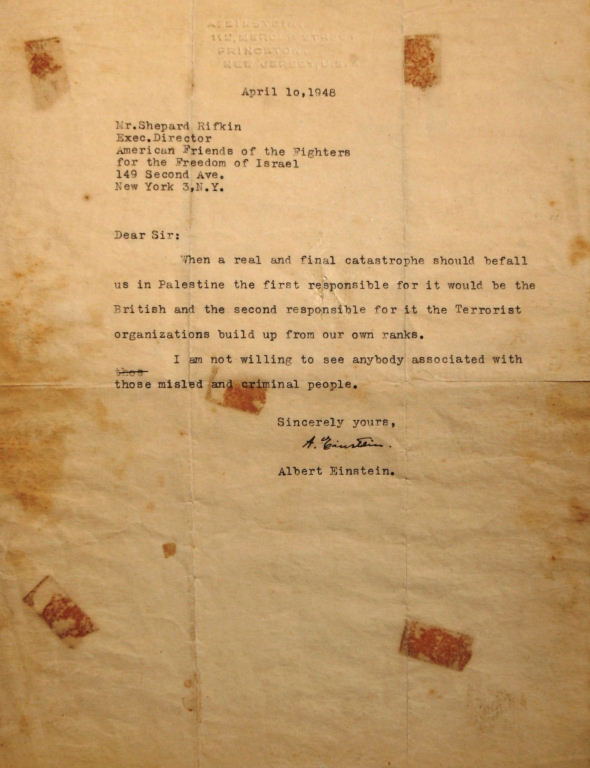
In 1948 zonden een aantal joodse intellectuelen, waaronder Hannah Arendt en Albert Einstein, een brief in aan de New York Times, waarin zij waarschuwden voor Menachem Begin. Begin was leider van de 'Vrijheidspartij' (Tnuat Haherut), "a political party closely akin in its organization, methods, political philosophy and social appeal to the Nazi and Fascist parties." En dat de partij was ontstaan uit de Irgun Zvai Leumi (Etzel), "a terrorist, right-wing, chauvinist organization in Palestine." Begin werd door een Britse rechtbank ter dood veroordeeld. Ondanks zijn terroristische verleden kozen de Israëliers hem tot premier (1977-1983), en in 1978 ontving hij de Nobelprijs voor de Vrede. (krantenknipsel .pdf bij Harvard, afbeeldingen hier)

Begin Irgun Etzel
Menachem Begin kust de Irgun-vlag op 4 augustus 1948, toen de terroristen opgingen in het Israëlische leger.


Het werk van Menachem Begin in Deir Yassin. Hij heeft er nooit spijt van gehad. Hij sleet zijn laatste dagen in een huis met een panoramisch uitzicht op Deir Yassin.


Aanslag op een Arabische bus door de Irgun, 17 doden, 29 december 1947


Het 'Etzel Huis', een museum ter nagedachtenis aan de Irgun, waarin de terroristen van weleer worden geëerd.


"Ter nagedachtenis van de bevrijders van Jaffa" Het museum is gehuisvest in een gestolen Arabisch huis in de wijk Manshiyya aan de rand van Jaffa, een dorp in de as gelegd door de Irgun-terroristen in 1948.


Eerbetoon aan de joodse "martelaren", waarvan sommigen zelfmoordterroristen.

Yosi Nachmiash (82) is een voormalige Irgun terrorist die de bezoekers van het museum onderhoudt met 'boeiende' verhalen over de 'operaties' waar hij bij betrokken was.

Meer informatie:
» Albert Einstein's geschreven reactie op een verzoek voor een gelddonatie voor de Stern Gang.
» 22 juli 2006: Israel celebrates Irgun hotel bombers