30 December 2020

Onderzoek: Hoe ernstig is uitkeringsfraude? (2)

Omdat mijn grafieken uit Onderzoek: Hoe ernstig is uitkeringsfraude? (1) nog steeds worden gedeeld op sociale media, en er de vraag was of er updates waren, deze post. Moet gezegd worden dat het steeds moeilijker wordt om algemene of jaarcijfers over fraude op het internet te vinden. In ieder geval in deze post een linkje naar de bron van de cijfers die ik opvoer. Want hoewel mensen zelf ook kunnen Googlen, ze willen het in hapklare brokken. Bij deze dan. Voor de contekst van deze post, lees die op Onderzoek: Hoe ernstig is uitkeringsfraude? (1)

De cijfers zijn gebaseerd op 1 jaar, de meesten van 2019, in 1 geval uit 2018 en 1 geval een schatting.


Werkelijke fraudecijfers Nederland 2019

Klik op de afbeelding voor ware grootte.

Bedragen x 1 miljoen | 1 categorie is uit 2018 en 1 categorie is een schatting


Zoekresultaten Google voor het jaar 2019

Klik op de afbeelding voor ware grootte.


Artikelen in de NRC

Klik op de afbeelding voor ware grootte.


Artikelen in de Telegraaf

Klik op de afbeelding voor ware grootte.


Artikelen in de Volkskrant

Klik op de afbeelding voor ware grootte.


Artikelen in Trouw

Klik op de afbeelding voor ware grootte.


Artikelen van de NOS

Klik op de afbeelding voor ware grootte.

22 August 2014

Everything you know about Hamas is wrong

Tim Holmes | 20.08.2014 | NEDERLANDS


Alright, not everything. And no, not you, smart-arse. Still, it’s been alarming to be reminded over the past month just how delusory much western public conversation on Hamas is. A common perception is that Hamas are in essence recalcitrant fundamentalist extremists, hell-bent on destroying Israel by any means possible. Virulently anti-semitic, misogynist and genocidal, they use whatever weapons they acquire to murder Israeli civilians and perhaps even attack Western targets internationally, without compunction or restraint. There is little awareness in this discourse that Hamas differ in any significant way from the Jihadists of ISIS or Al-Qaeda.

Probably the most valuable basic text in dispelling these delusions is Khaled Hroub’s Hamas: A Beginner’s Guide, which takes on most of the major confusions and misconceptions surrounding the group’s seldom-explained ideology and modus operandi. Hroub is a senior research fellow at the University of Cambridge’s Centre of Islamic Studies as well as Director of its Arab Media Project, and his work on Hamas is held in very high regard: Foreign Affairs deems it “masterful”; Columbia’s Joseph Massad calls it “the best-researched and most objective” work on the topic, while Harvard’s Sara Roy, a leading expert on the Israel-Palestine conflict, calls it “excellent” and “required reading”.


Firstly, are Hamas anti-Semitic? Hroub’s careful answer is that, though there have been manifold confusions in Hamas’s writings and rhetoric between Jews, Zionists and Israelis, Jewishness is neither a necessary nor a sufficient condition for Hamas’s opposition. The group draw a sharp distinction, for instance, between “Zionist and non-Zionist” Jews:

“The non-Zionist Jew is one who belongs to the Jewish culture, whether as a believer in the Jewish faith or simply by accident of birth, but … [who] takes no part in aggressive actions against our land and our nation … Hamas will not adopt a hostile position in practice against anyone because of his ideas or his creed but will adopt such a position if those ideas and creed are translated into hostile or damaging actions against our people.”

Rather, it is the occupation and dispossession of the Palestinians that evokes Hamas’s resistance. As one of its leaders puts it:

“being Jewish, Zionist or Israeli is irrelevant, what is relevant for me is the notion of occupation and aggression. Even if this occupation was imposed by an Arab or Islamic state and the soldiers were Arabs or Muslims I would resist and fight back.

Are Hamas committed to the destruction of Israel? In fact, Hroub writes, this phrase is “never used or adopted by Hamas, even in its most radical statements.” Rather, Hamas seeks “the liberation of Palestine.” While this initially meant historic Palestine in its entirety, Hamas are a generally pragmatic organisation rooted in, and responsive to, the needs and wishes of Palestinian society, and in practice back a two-state solution along the lines of the international consensus: Israeli withdrawal from the territories it occupied in 1967, and a Palestinian state in Gaza and the West Bank. They frame this in terms of a long-term hudna or “truce” – a term rooted in Islamic tradition that Hamas draw on to justify suspensions of its jihad, or struggle. The group have floated the idea of a Palestinian referendum as a path to a final settlement, allowing the movement to reconcile its initial, hard-line position with its present, pragmatic stance. Hamas state that they would accept whatever outcome the Palestinians themselves chose.

Most commonly invoked to incite alarm about Hamas’s supposed anti-Semitism is its (to cite Roy) “undeniably racist and anti-Jewish” Charter. Yet this document is a singularly unhelpful guide to the modern movement. As Hroub points out:

“The Charter was written in early 1988 by one individual and was made public without appropriate general Hamas consultation, revision or consensus … The author of the Charter was one of the “old guard” of the Muslim Brotherhood in the Gaza Strip, completely cut off from the outside world”.

The document is therefore regarded as an embarrassment, rarely referenced or cited, and starkly divergent from Hamas’s current thinking. As the organisation’s chief, Khaled Meshal, told the New York Times in 2009:

“The most important thing is what Hamas is doing and the policies it is adopting today. . . . Hamas has accepted the national reconciliation document. It has accepted a Palestinian state on the 1967 borders including East Jerusalem, dismantling settlements, and the right of return based on a long-term truce. Hamas has represented a clear political program through a unity government. This is Hamas’s program regardless of the historic documents. Hamas has offered a vision. Therefore, it’s not logical for the international community to get stuck on sentences written 20 years ago.”

As one official US government agency concluded the same year:

“Hamas has, in practice, moved well beyond its charter. Indeed, Hamas has been carefully and consciously adjusting its political program for years and has sent repeated signals that it may be ready to begin a process of coexisting with Israel.”

Is Hamas an utterly intransigent, implacably violent organisation pursuing genocidal aims? In fact, its leaders have repeatedly proposed a long-term truce with Israel of 10, 20 or 30 years’ duration (with the possibility of continual renewal thereafter), and it has shown itself willing to accept and carefully observe ceasefires. In thewords of Avi Shlaim, probably the best-respected historian of the Israeli-Arab conflict:

“The historical record shows that despite its terrible Charter, Hamas is led by pragmatic political leaders who have settled for a two-state solution along the 1967 lines, and who have made every effort to end the conflict by diplomatic means.

Such efforts, Shlaim notes, include offers to negotiate a long-term truce following its election in 2006, a reprisal of that offer after it formed a national unity government in 2007 – which met with a US-Israeli-Fatah coup attempt – and in the national unity government of 2014, which saw Hamas essentially cede power (gaining no ministerial positions) while agreeing to recognise Israel, renounce violence and respect past agreements. Over the last month, the media have hyped Hamas’ rejection of a ceasefire deal stitched up between its enemies Egypt and Israel without any Hamas involvement – which, since it would see Hamas lose ground from the previous ceasefire agreement Israel was continually violating, was impossible for Hamas to accept. Nonetheless, Hamas quickly responded with its own, long-term (10-year) ceasefire offer – which Israel rebuffed.

2009’s Operation Cast Lead, Shlaim notes, a bloody massacre in which Israel killed over 1,000 Palestinians – most of them civilians – was likewise the result of Israeli provocation and belligerence in the face of Hamas restraint:

“In June 2008, Egypt had brokered a ceasefire between Israel and Hamas, the Islamic resistance movement. Contrary to Israeli propaganda, this was a success: the average number of rockets fired monthly from Gaza dropped from 179 to three. Yet on 4 November Israel violated the ceasefire by launching a raid into Gaza, killing six Hamas fighters. When Hamas ­retaliated, Israel seized the renewed rocket attacks as the excuse for launching its insane offensive. If all Israel wanted was to protect its citizens from Qassam rockets, it only needed to observe the ceasefire.

Further back, Hamas sharply opposed the Oslo peace process of the 1990s (though later participated in the elections it established), but in the context of sharp divisions of opinion and serious reservations across Palestinian society. Many of its objections, echoing those of the left, have been vindicated. “One of the meanings of Oslo,” notes Israeli ex-minister Shlomo Ben-Ami,

“was that the PLO was … Israel’s collaborator in the task of stifling the intifada and cutting short what was clearly an authentically democratic struggle for Palestinian independence.”

Moreover:

“As a matter of fact, neither Rabin nor, especially, Peres [1992-96 Labor Prime Ministers] wanted the autonomy to usher in a Palestinian state. As late as 1997 – that is, four years into the Oslo process when, as the chairman of the Labour Party’s Foreign Affairs Committee, I proposed for the first time that the party endorse the idea of a Palestinian state – it was Shimon Peres who most vehemently opposed the idea. … A Palestinian state was clearly not within Rabin’s priorities either.”

Hamas’ tactic of suicide bombings against Israeli civilians – morally abhorrent and a crime against humanity – did its international reputation no favours, doubtless added credibility to the allegation of genocidal intent, and may have encouraged more extreme groups to adopt the tactic. Nevertheless, this chequered history does not alter Hamas’s real strategic aims. Its leaders declare that “resistance is not an end in itself”; as the movement’s spiritual leader Sheikh Ahmed Yasin put it in September 2003:

“If we perceive that the atmosphere favours such a decision, we stop. And when we perceive that the atmosphere has changed, we carry on.”

Far from an end in themselves, suicide bombings were a tactic. Hamas first launched them in 1994, following far-right settler Baruch Goldstein’s vicious massacre of 29 Palestinian worshippers in Hebron’s Abrahimic mosque – but, Hroub notes, quickly realised they “provided the movement with an aura of strength and popularity” amongst Palestinians. Israel hinted that it was willing to negotiate an end to these attacks, but Hamas’s position – “stop killing Palestinian civilians and we will stop killing Israeli civilians” – proved a non-starter for the Israeli government. (During the second intifada, the number of Palestinian children killed was greater than the number of Israeli civilians killed.) Between 2000 and 2005, “tacit agreements” to halt attacks routinely expired as “Israel would waste no opportunity to assassinate one Hamas leader after another”. Indeed evidence suggests Israel overwhelmingly shoots first during a lull.

Hamas differs starkly from Al-Qaeda-style jihadists, then, in its aims, means, targets and fundamental nature. Hamas began by seeking the liberation of historic Palestine, ultimately narrowing that aim to ending the occupation of Gaza and the West Bank. Al-Qaeda’s focus, by contrast, is pan-Islamic: it seeks to kick the West out of Arab and Muslim countries, tear down corrupt puppet governments and instate hard-line Taliban-style regimes across the Muslim world. Its battleground is global: Al-Qaeda targets the US, the western “Crusader states” that attack Muslim countries, Muslim “apostates” (a category that includes Hamas) and westerners anywhere, ruling out democratic and peaceful means. Far from pursuing any such “global jihad”, Hamas strictly limits its operations to historic Palestine, and has never targeted Westerners. In 2006, for instance, Cechen rebels urged Hamas to break off relations with Moscow over its horrific crimes in Chechnya; Hamas declined, concluding that relations with Moscow were of more value to the Palestinian struggle. It is also a democratic organisation, in some ways to a fault, Hroub suggests: electing senior figures one by one can give it a chaotic leadership structure. Overall, Hamas resemble a national liberation movement far more than a transnational jihadist network.

Early rhetoric about creating an Islamic state is no longer taken seriously – if it ever was – and Hamas now expresses a pluralist outlook, deriving its terminology from international law and mainstream political theory. Again, this reflects its roots in Palestinian society and need to maintain its base of support. Hamas enjoys some electoral support among Christians, backed two independent Christian candidates in the 2006 elections, and appointed a Christian to its ministerial team. Nevertheless, Hroub writes, some research suggests its rule has put pressure on Christian groups, increasing rates of emigration, and moves to impose some conservative Islamic moral codes on Palestinian society have elicited anger and alarmed secularists. In the past, Hroub notes, these have included “soft” forms of influence – through provision of social services, for instance – as well as occasionally “harder”, more forceful forms from some members, though its leadership generally kept them in check. (Human rights groups have also condemned its arrests of journalists and serious abuses against alleged “collaborators”.) Nevertheless, Roy notes Hamas’s “progressive de-emphasis on religion” in power, alongside “the emerging Islamization of Palestinian society and politics”.

Reports of Hamas employing “human shields” and diverting humanitarian resources into fanatical militarism depict a fundamentally despotic organisation – malign toward and parasitic on ordinary Palestinians. This idea has roots in both Orientalist portrayals of Arab leaders and more recent Israeli government propaganda, but largely inverts reality. In fact, Hamas derives popularity not only from concerted resistance to occupation but also the widespread social assistance that forms the bulk of its work, helping sustain Palestinians through increasingly dire poverty. As Roy puts it:

“During the Oslo period especially, the strength of Hamas increasingly lay in the work of Islamic social institutions whose services, directly and indirectly, reached tens if not hundreds of thousands of Palestinians, helping them to survive. They provided services that the Palestinian Authority was unable to provide adequately, if at all. This base supported Islamic institutions largely because they met basic needs for economic sustenance and community well-being with a focus on health and education, community support, and service delivery. Islamic institutions were increasingly viewed as community actors in a context where few such actors existed. … Islamic institutions did not emphasize political violence or substate terrorism but rather community well-being and civic restoration, a role that was (and remains) vital in a context of steady deterioration.”

In power, Hamas’s smashed and vilified tunnels actually provided a lifeline for Gaza’s crippled economy. Hamas’s conspicuous material modesty has also increased its popularity in contrast to the corrupt Fatah leadership. Equally, journalists and human rights monitors find no evidence that Hamas uses “human shields”, but uncover extensive evidence of the practice by Israel – which also, of course, sites military facilities near major populated areas, subsidises the housing of civilians in a war zone, and deliberately risks the lives of captured IDF soldiers.

As Roy concludes:

“While there can be no doubt that since its inception in 1987, Hamas has engaged in violence, armed struggle, and terrorism as the primary force behind the horrific suicide bombings inside Israel, it is also a broadbased movement that has evolved into an increasingly complex, varied, and sophisticated organization engaged in a variety of societal activities vital to Palestinian life.”

To westerners, this may come a surprise. But then, since when has any of us received sane, reasonable commentary from the nightly Two Minutes Hate?

3 August 2014

Living through war ~ by Karam Eleiwa from Gaza

A heartwrenching message from 16-year old Karam Eleiwa who lives in Gaza. We will not find this in a newspaper, but I think it's well worth reading. First hand accounts of what's going on in Gaza, from ordinairy people like you and me, are very educational.

Occupied Palestine | By Karam Eleiwa | 03.08.2014 | NEDERLANDS


What is it like to live in war?


Everything in life has it’s own advantages and disadvantages. When it comes to war on Gaza, a 360 square kilometers piece of land with the highest population density in the world, it is different. Every bomb that is dropped costs, whether is costs human lives or destroys homes that people worked their entire life to build. Now they have to work the rest of their lives trying to rebuild what they had of memories in these homes.


Try to imagine receiving a phone-call telling you to evacuate your home in 3 minutes because it’s going to get bombed. Try to imagine leaving all the memories behind Memories of pain and joy alike. How would if feel?


A miracle happened in Gaza in which a baby was rescued from a womb of a dead mother. Ironically the miracle didn’t last for long as if the baby refused to be away from her mother. A week after her birth, the baby died because of the lack of electricity.
The baby made it through the shelling that killed her mother, but couldn’t make it due to electricity cut that was needed to resuscitate her. What an irony!


Let’s talk about electricity…. Hi….. Here… Sorry, electricity just went off and it might return. Don’t worry. Here’s a small fact, Gaza’s only power-plant has been completely destroyed by the Israeli air-force shelling and it requires about a year to be ready to work again.


Palestinians are paying a remarkable price of their blood and belongings due to the silence of the Arab nations and the world’s ignorance of the massacres taking place on the ground in Gaza.


In Shaja’eya, one of the largest and oldest neighborhoods in eastern Gaza, a dead family was witnessed holding each others hands as if they knew their fate. Also in Khuza’a, a small village east of Khan Yunis in the south, around 13 children were shot by Israeli snipers.
Sadly, the media pictures Hamas throwing rockets back as this is an equal war.


Where are the safe places now in Gaza? Well, Shaja’eya, Khuza’a, and probably Rafah. Why are they safe? Simple, because there is nothing left there to be bombed.


Shaja’eya witnessed the immigration of 90,000 humans from their own homes. Shaja’eya buried 72 martyrs and cried over 3,700 homes that were completely destroyed. Still some people refuse to give up. They either died, got injured, or were lucky to survive.


This is a story about humans who waited more than 10 years to have a child. They were lately blessed with one who, sadly, along with three others were killed while they were playing on the beach. Now, his parents lie in pain.


Pan Ki Mon, the UN Secretary General and John Kerry the US Secretary of State have announced a 72 hours ceasefire for the sake of humanity. Unfortunately, a massacre in Rafah, south of Gaza Strip, took place during the ceasefire while people were shopping for their needs. It is painful how these people lost their lives. More than 100 martyrs were piled up in refrigerators waiting to get buried instead of them piling up their groceries in their homes.


Although the war has many disadvantages, these are some advantages. First, families bond as they sit together in their unsafe hiding place talking to each other and knowing more about each other, while relatives from outside call to check on their families. And last, ironically, with the destruction of the power plant, Gaza somehow became eco-friendly, though I had hoped for this to happen without a war.


Now after you have seen the costs ( disadvantages ) and advantages, think!
A word to the humans in the world; be humans!


by Karam Eleiwa 16 years old Gazan

21 July 2014

War crime: video shows sniper killing of wounded Gaza civilian

The Electronic Intifada | By Ali Abunimah | 21.07.2014 | NEDERLANDS


A video has emerged of the targeting and killing by a sniper of a Palestinian civilian in Gaza City’s Shujaiya neighborhood where Israeli shelling killed dozens of civilians and caused massive destruction early on Sunday morning.

The video, documenting a war crime, was uploaded to YouTube by the International Solidarity Movement, which described the incident in a 20 July press release:

The Israeli military just shot a Gazan man trying to reach his family, during an announced ceasefire. He was with a group of municipality workers and international human rights defenders who were attempting to retrieve injured people in the Shujaiya neighborhood.

“We all just watched a man murdered in front of us. He was trying to reach his family in Shujaiya, he had not heard from them and was worried about them. They shot him, and then continued to fire as he was on the ground. We had no choice but to retreat. We couldn’t reach him due to the artillery fire and then he stopped moving.” Stated Joe Catron, US International Solidarity Movement (ISM) activist in Gaza. “Shajiya is a smoking wasteland. We just passed two bombed out ambulances.”

The Israel military has also shelled Red Crescent ambulances as they attempted to retrieve injured people in the Shujaiya neighbourhood, east of Gaza City. A ceasefire was announced, during which injured and dead people, could be evacuated from the area, in which at least 60 people have been killed today.

“They said we would be able to evacuate the injured from the disaster zone, but they have been shelling ambulances,” stated Dr Khalil Abu Foul of the Palestinian Red Crescent, speaking from Shujaiya.
Now, the international volunteers, including some from the US, the UK, and Sweden, are in a rescue centre on the outskirts of Shujaiya.

Catron is also a frequent contributor to The Electronic Intifada.


Read more

20 July 2014

Patching up torture victims in an open-air prison

The Independent | By Robert Fisk | 17.07.2014 | NEDERLANDS

ROBERT FISK
Thursday 17 July 2014

Israel-Gaza conflict: Medical charity official likens job to ‘patching up torture victims in an open-air prison’

Comments by senior Médecins Sans Frontières official expose ethical dilemma of humanitarian work in conflict zones


In an unprecedented criticism of the Israeli siege of Gaza, a senior official in the Médecins Sans Frontières (MSF) humanitarian charity has described his organisation’s work among the 1.8 million besieged Palestinian refugees as akin to being “in an open-air prison to patch up prisoners in between their torture sessions”.

Jonathan Whittall, head of humanitarian analysis at MSF, who worked in Libya during the 2011 war, in Bahrain during the uprising of the same year, in Syria, Afghanistan, Pakistan, South Sudan and Darfur, has bluntly asked his colleagues: “At what point does MSF’s repeated medical action in an unacceptable situation [like Gaza] become complicity with aggression and oppression?”

Unlike other medical charities, MSF has always encouraged its staff to speak frankly about the dangers and moral problems they face, and the long and passionate report from Mr Whittall – unlike those of other humanitarian groups, which prefer to silence their staff – is in keeping with MSF’s rules. But its accusations against Israel are sure to arouse fierce Israeli condemnation during a disproportionate war – supposedly fought to prevent Hamas rocket attacks on Israel – in which the Israeli military has killed well over 200 civilians, many of them women and children.

“An entire population is trapped in what is essentially an open-air prison,” Mr Whittall writes. “They can’t leave and only the most limited supplies – essential for basic survival – are allowed to enter. The population of the prison have elected representatives and organised social services.

“Some of the prisoners have organised into armed groups and resist their indefinite detention by firing rockets over the prison wall. However, the prison guards are the ones who have the capacity to launch large-scale and highly destructive attacks on the open-air prison.”

In a comparison which is also certain to infuriate Israel, Mr Whittall, who is based in Beirut, says that the limitations of humanitarian groups in Gaza are not unique. “In 2012,” he writes, “MSF closed its projects in the prisons of Misrata, Libya. Our doctors were outraged to be in a position where we were providing treatment to patients who were being tortured by state authorities. At the time, MSF spoke out strongly: ‘Our role is to provide medical care to war casualties and sick detainees, not repeatedly to treat the same patients between torture sessions’.”


Since 2010, MSF has run a post-operation clinic in Gaza City, where 80 per cent of the patients suffer from severe burns, and provides specialised hand surgery in the Nasser hospital at Khan Younis, and intensive care training to medical and paramedical personnel at both the Nasser and Shifa hospitals.

During conflict, Mr Whittall adds, “the voice of outrage of MSF medical teams is drowned out by the propaganda war that erupts each time a [military] operation such as this takes place and by the concerns that too loud a voice of criticism could cut off the organisation’s surgical teams from being able to reach the Gaza Strip.” Although Mr Whittall does not say so, the same constraints were felt by humanitarian groups when confronted by civilian populations in desperate need of help in the Syrian war.

In another sideswipe at the Israeli military’s actions against Gaza, Mr Whittall remarks that “everyone pays the price for living under siege and for their acts of resistance. Medical workers have been killed and health structures damaged. In such a densely populated environment, the claims of not targeting civilians in air raids are of little comfort. There are always limits to humanitarian action. Humanitarian organisations can treat the wounded. But we can’t open borders to end violence.”

The MSF official also notes that while confronting the “limits of humanitarianism” is a daily reality for MSF field workers, “it is made only more apparent by the duration of the suffering and the international political configuration that allows for the sick political statements and endless violence to continue.” Mr Whittall says that as “the open-air prison of Gaza braces for more air raids and a possible ground operation,” the limits of MSF’s work remain obvious, and he demands that Palestinians should be allowed “to move freely and to seek safety in times of violence, including into Egypt… Civilians and civilian infrastructure – including medical workers, health centres and ambulances – should never be targeted. Humanitarian aid and its workers should be given unhindered access at all times – not as a favour but as a legal responsibility.”


Smoke from rockets fired from a northern neighborhood of Gaza City are seen after being launched toward Israel

Mr Whittall’s analysis will evoke much sympathy among other humanitarian organisations, and with EU officials who find that their assistance in the Palestinian occupied territories or Gaza is taken for granted – or even abused – by the Israelis. EU humanitarian projects, both in Gaza and the West Bank, have been destroyed by the Israeli army – with afterwards scarcely a breath of criticism from the EU itself, which has no connection with MSF.

19 July 2014

Israel accused of war crimes in UK Parliament (July 15, 2014)


Highlights from a UK parliamentary debate in which MPs variously accused Israel of war crimes, disproportionate violence, ruining peace negotiations by building illegal settlements, running the worlds largest outdoor prison, collective punishment, and attacking water supplies, hospitals, supply centres and all manner of other civilian targets. I have edited out the contributions of Foreign Secretary, William Hague, because nearly all of them displayed a shameful lack of compassion for the sufferings of the Palestinian people (Hague is a prominent member of an organisation called the "Conservative Friends of Israel" and is well aware of the funding that involvement brings to his party and his own political campaigns)
The debate took place on the 14th of July 2014

Robert Parry: The Human Price of Neocon Havoc

consortiumnews.com | By Robert Parry | 17.07.2014 | NEDERLANDS

The Human Price of Neocon Havoc


Exclusive: Neocons are the “masters of chaos” as they destabilize disfavored governments around the world. But real people pay the price as we’ve seen with Israel’s slaughter of four boys on a Gaza beach and an apparent shoot-down of a Malaysian airliner over war-torn Ukraine, writes Robert Parry.

By Robert Parry

Whether the tragedy is four boys getting blown apart while playing on a beach in Gaza or nearly 300 killed from a suspected missile strike on a Malaysian Airliner over Ukraine or the thousands upon thousands of other innocent victims slaughtered in Iraq, Syria, Libya and other recent war zones, the underlying lesson is that the havoc encouraged by America’s neocons results in horrendous loss of human life.

While clearly other players share in this blame, including the soldiers on the ground and the politicians lacking the courage to compromise, the principal culprits in the bloodshed of the past dozen years have been the neoconservatives and their “liberal interventionist” allies who can’t seem to stop stirring up trouble in the name of “democracy” and “human rights.”
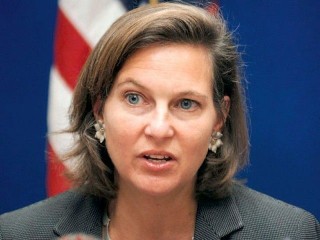
Assistant Secretary of State for European Affairs Victoria Nuland, who pushed for the Ukraine coup and helped pick the post-coup leaders.
Rather than work out reasonable – albeit imperfect – compromises with various foreign leaders, the neocons and their liberal allies insist on ratcheting up demands to such unrealistic levels that conflict becomes inevitable and the outcomes are almost always catastrophic.

In Iraq in 2003, the neocons and many liberal fellow-travelers insisted that the only acceptable solution was the violent removal of Saddam Hussein through an unprovoked U.S. invasion. Though Hussein was ousted and hanged, the collateral damage included hundreds of thousands of dead Iraqis, including many children, along with the complete destabilization of the country.

In Syria and Libya, many of the same U.S. actors – although in this case led by the liberal “responsibility-to-protect” crowd – pushed for the overthrow of the existing governments, supposedly to save lives and spread democracy.
In Libya, the U.S.-led air war did cause Muammar Gaddafi to be overthrown and murdered but the ensuing chaos has led to many more deaths, including U.S. Ambassador Christopher Stevens, plus the spread of Islamic militancy across the region.

In Syria, the U.S.-backed “regime change” bid failed to overthrow President Bashar al-Assad but the resulting chaos has left more than 100,000 people killed and has given rise to an ultra-violent jihadist group called the Islamic State, which first emerged from the U.S.-created war in Iraq and has now boomeranged back onto Iraq as the jihadists have seized major cities and spurred more sectarian killings.

But there may be a method to the apparent neocon madness. The neocons have always been committed to protecting Israel and enabling its oppression of Palestinians on the West Bank and Gaza. Indeed, one can understand pretty much every confrontational policy pushed by the neocons as being designed to serve Israeli interests.

These “regime change” schemes can be directly traced to the work of prominent U.S. neocons on Benjamin Netanyahu’s 1996 campaign for Israeli prime minister. Rather than continuing inconclusive negotiations with the Palestinians, Netanyahu’s neocon advisers – including Richard Perle, Douglas Feith, David Wurmser and Mevray Wurmser – advocated an aggressive new approach, called “A Clean Break: A New Strategy for Securing the Realm.”

Essentially, the neocon thinking arose from Israeli frustration over negotiations with the Palestinians. The Israelis were angry at Palestinian leader Yasser Arafat and the militant group Hamas as well as Lebanon’s Hezbollah. So the “clean break” scratched negotiations and replaced talking with “regime change” in countries supporting those groups, whether Iraq under Saddam Hussein, Syria under the Assad dynasty or Iran, a leading benefactor of Syria, Hezbollah and Hamas.

Two years later, in 1998, came the neocon Project for the New American Century’s call for a U.S. invasion of Iraq. PNAC was founded by neocon luminaries William Kristol and Robert Kagan. [See Consortiumnews.com’s “The Mysterious Why of the Iraq War.”]

Helpful Chaos

Though many of the neocon plans have not worked out as advertised – the promised “cakewalk” in Iraq turned into a bloody slog – the neocon strategy could still be labeled a success if the actual intent was to destabilize and weaken Middle Eastern countries that were perceived as threats to Israel.
Through that lens, it’s not entirely bad that old sectarian hatreds have been revived, pitting Sunni against Shiite and ripping apart societies such as Iraq, Syria and Lebanon. In the end, the regional chaos has helped Prime Minister Netanyahu starve the Palestinians of the financial support that they once had, supposedly making them more susceptible to whatever demands the Israelis choose to make. And it has given Netanyahu a freer hand to engage in periodic slaughters of Gazan militants, a process that Israelis call “mowing the grass.”

When the 1.7 million Palestinians packed into the Gaza Strip lash out at their Israeli oppressors – as they periodically do – the neocons who remain very influential in Official Washington are quick to dominate the U.S. media, justifying whatever levels of violence that Netanyahu chooses to inflict. But raining bombs down on this densely populated area is sure to kill many children and other innocents.
On Wednesday, the Israeli military targeted a shed on the beach in Gaza. According to reports, the first missile hit the shed and killed one small boy playing in the vicinity. When three other boys began running, the Israelis blew them away with a second rocket. New York Times photographer Tyler Hicks explained the events this way:

“A small shack atop a sea wall at the fishing port had been struck by an Israeli bomb or missile and was burning. A young boy emerged from the smoke, running toward the adjacent beach. I grabbed my cameras and was putting on body armor and a helmet when, about 30 seconds after the first blast, there was another. The boy I had seen running was now dead, lying motionless in the sand, along with three other boys who had been playing there.”

Presumably, the Israeli pilots or whoever targeted the missile deserve the immediate blame for this atrocity. But the far-worse criminals are the Israeli leaders who refuse to address the longstanding injustices inflicted on the Palestinian people. Also, sharing in this crime are the American neocons who justify whatever Israel does.

Similarly, it has been the neocons and their “liberal interventionist” allies who have been stoking the crisis in Ukraine in part out of a desire to drive a wedge between President Barack Obama and Russian President Vladimir Putin, who has assisted Obama in defusing crises in Syria and Iran, two areas where the neocons hoped to engineer more “regime change.”

By last September, leading neocons, such as National Endowment for Democracy President Carl Gershman, had identified Ukraine as the geopolitical instrument for punishing Putin. Gershman deemed Ukraine “the biggest prize” and hoped that grabbing it for the Western sphere of influence might undercut Putin at home as well.

Gershman’s NED funded scores of Ukrainian political and media organizations while Assistant Secretary of State Victoria Nuland estimated that the U.S. government had invested $5 billion in the cause of pulling Ukraine into the West. Nuland, a neocon holdover who had been a top adviser to Vice President Dick Cheney, is the wife of PNAC co-founder Robert Kagan.

Nuland went so far as to show up at mass demonstrations in Kiev’s Maidan Square passing out cookies to the protesters, while neocon Sen. John McCain stood with the far-right Svoboda Party – under a banner honoring Nazi collaborator Stepan Bandera – to urge on the protesters to challenge elected President Viktor Yanukovych. [See Consortiumnews.com’s “What the Neocons Want from Ukraine Crisis.”]

Wreaking Havoc

The political crisis in Ukraine reached a boiling point Feb. 20-22 as the demonstrations turned increasingly violent and the death toll among police and protesters mounted. On Feb. 21, three European foreign ministers reached an agreement with Yanukovych in which he agreed to limit his powers and accept early elections to vote him out of office. He also pulled back the police, as Vice President Joe Biden had demanded.

At that point, however, well-trained neo-Nazi militias – organized in brigades of 100 – took the offensive, seizing government buildings and forcing Yanukovych’s officials to flee for their lives. Instead of trying to enforce the Feb. 21 agreement, which would have safeguarded Ukraine’s constitutional process, the U.S. State Department cheered the unlawful ouster of Yanukovych and quickly recognized the coup regime as “legitimate.”

The Feb. 22 coup set in motion a train of other events as “ethnically pure” Ukrainians in the west were pitted against ethnic Russians in the east and south. The crisis grew bloodier as the ethnic Russians resisted what they regarded as an illegitimate regime in Kiev.

Meanwhile, the U.S. mainstream press – always enthralled to the neocons – pushed a false narrative about Ukraine that put nearly all the blame on Putin, though he clearly was reacting to provocations instigated by the West, not the other way around.

Still, the neocons achieved one of their chief goals, alienating Obama from Putin and making the two leaders’ collaboration on Syria, Iran and other trouble spots more unlikely. In other words, the neocons have kept alive hope that those problems won’t be resolved through compromise, but rather might still lead to more warfare.

While some Machiavellians might admire this neocon “always-say-die” determination, the human consequences can be quite severe. For instance, the violence in eastern Ukraine may have led to the Thursday crash of a Malaysian Airliner flying from Amsterdam to Kuala Lumpur with all 295 people onboard killed.

It was not immediately clear which side in the fighting – if any – was responsible for the suspected shoot-down of the plane. The various parties to the conflict all denied responsibility. But it would not be the first time that an international conflict has contributed to the destruction of a civilian airliner.
On July 3, 1988, the USS Vincennes shot down Iran Air Flight 655 over Iranian territorial waters in the Persian Gulf, killing all 290 people onboard, after apparently mistaking the airliner for a warplane.

While Ukraine’s new President Petro Poroshenko was quick to call the crash “a terrorist act” – and implicitly blame the ethnic Russian rebels – the reality is almost assuredly that it was an accident (assuming that a missile did bring down the airliner). Presumably, the same is true about the Israeli twin missile strikes killing those four boys on a beach in Gaza. The Israeli military most likely misjudged their ages.

But the overriding lesson from these tragedies should be that the real villains are people who opt for chaos and war over progress and peace. And, in the case of the Middle East and Ukraine, the greatest purveyors of this unnecessary warfare are America’s neocons.

Investigative reporter Robert Parry broke many of the Iran-Contra stories for The Associated Press and Newsweek in the 1980s. You can buy his new book, America’s Stolen Narrative, either in print here or as an e-book (from Amazon and barnesandnoble.com). For a limited time, you also can order Robert Parry’s trilogy on the Bush Family and its connections to various right-wing operatives for only $34. The trilogy includes America’s Stolen Narrative. For details on this offer, click here.


18 July 2014

Ukraine, US, Russia

In Ukraine, the US is dragging us towards war with Russia
Washington's role in Ukraine, and its backing for the regime's neo-Nazis, has huge implications for the rest of the world

The Guardian | By John Pilger | → 13.05.2014 ← | NEDERLANDS


A pro-Russian activist with a shell casing and a US-made meal pack that fell from a Ukrainian army APC in an attack on a roadblock on 3 May in Andreevka, Ukraine. Photograph: Scott Olson/Getty

Why do we tolerate the threat of another world war in our name? Why do we allow lies that justify this risk? The scale of our indoctrination,wrote Harold Pinter, is a "brilliant, even witty, highly successful act of hypnosis", as if the truth "never happened even while it was happening".

Every year the American historian William Blum publishes his "updated summary of the record of US foreign policy" which shows that, since 1945, the US has tried to overthrow more than 50 governments, many of them democratically elected; grossly interfered in elections in 30 countries; bombed the civilian populations of 30 countries; used chemical and biological weapons; and attempted to assassinate foreign leaders.

In many cases Britain has been a collaborator. The degree of human suffering, let alone criminality, is little acknowledged in the west, despite the presence of the world's most advanced communications and nominally most free journalism. That the most numerous victims of terrorism – "our" terrorism – are Muslims, is unsayable. That extreme jihadism, which led to 9/11, was nurtured as a weapon of Anglo-American policy (Operation Cyclone in Afghanistan) is suppressed. In April the US state department noted that, following Nato's campaign in 2011, "Libya has become a terrorist safe haven".

The name of "our" enemy has changed over the years, from communism to Islamism, but generally it is any society independent of western power and occupying strategically useful or resource-rich territory, or merely offering an alternative to US domination. The leaders of these obstructive nations are usually violently shoved aside, such as the democrats Muhammad Mossedeq in Iran, Arbenz in Guatemala andSalvador Allende in Chile, or they are murdered like Patrice Lumumba in the Democratic Republic of Congo. All are subjected to a western media campaign of vilification – think Fidel Castro, Hugo Chávez, now Vladimir Putin.

Washington's role in Ukraine is different only in its implications for the rest of us. For the first time since the Reagan years, the US is threatening to take the world to war. With eastern Europe and the Balkans now military outposts of Nato, the last "buffer state" bordering Russia – Ukraine – is being torn apart by fascist forces unleashed by the US and the EU. We in the west are now backing neo-Nazis in a country where Ukrainian Nazis backed Hitler.

Having masterminded the coup in February against the democratically elected government in Kiev, Washington's planned seizure of Russia's historic, legitimate warm-water naval base in Crimea failed. The Russians defended themselves, as they have done against every threat and invasion from the west for almost a century.

But Nato's military encirclement has accelerated, along with US-orchestrated attacks on ethnic Russians in Ukraine. If Putin can be provoked into coming to their aid, his pre-ordained "pariah" role will justify a Nato-run guerrilla war that is likely to spill into Russia itself.

Instead, Putin has confounded the war party by seeking an accommodation with Washington and the EU, by withdrawing Russian troops from the Ukrainian border and urging ethnic Russians in eastern Ukraine to abandon the weekend's provocative referendum. These Russian-speaking and bilingual people – a third of Ukraine's population – have long sought a democratic federation that reflects the country's ethnic diversity and is both autonomous of Kiev and independent of Moscow. Most are neither "separatists" nor "rebels", as the western media calls them, but citizens who want to live securely in their homeland.

Like the ruins of Iraq and Afghanistan, Ukraine has been turned into a CIA theme park – run personally by CIA director John Brennan in Kiev, with dozens of "special units" from the CIA and FBI setting up a "security structure" that oversees savage attacks on those who opposed the February coup. Watch the videos, read the eye-witness reports from the massacre in Odessa this month. Bussed fascist thugs burned the trade union headquarters, killing 41 people trapped inside. Watch the police standing by.

A doctor described trying to rescue people, "but I was stopped by pro-Ukrainian Nazi radicals. One of them pushed me away rudely, promising that soon me and other Jews of Odessa are going to meet the same fate. What occurred yesterday didn't even take place during the fascist occupation in my town in world war two. I wonder, why the whole world is keeping silent." [see footnote]

Russian-speaking Ukrainians are fighting for survival. When Putin announced the withdrawal of Russian troops from the border, the Kiev junta's defence secretary, Andriy Parubiy – a founding member of the fascist Svoboda party – boasted that attacks on "insurgents" would continue. In Orwellian style, propaganda in the west has inverted this to Moscow "trying to orchestrate conflict and provocation", according to William Hague. His cynicism is matched by Obama's grotesque congratulations to the coup junta on its "remarkable restraint" after the Odessa massacre. The junta, says Obama, is "duly elected". As Henry Kissinger once said: "It is not a matter of what is true that counts, but what is perceived to be true."

In the US media the Odessa atrocity has been played down as "murky" and a "tragedy" in which "nationalists" (neo-Nazis) attacked "separatists" (people collecting signatures for a referendum on a federal Ukraine). Rupert Murdoch's Wall Street Journal damned the victims – "Deadly Ukraine Fire Likely Sparked by Rebels, Government Says". Propaganda in Germany has been pure cold war, with the Frankfurter Allgemeine Zeitung warning its readers of Russia's "undeclared war". For the Germans, it is a poignant irony that Putin is the only leader to condemn the rise of fascism in 21st-century Europe.

A popular truism is that "the world changed" following 9/11. But what has changed? According to the great whistleblower Daniel Ellsberg, a silent coup has taken place in Washington and rampant militarism now rules. The Pentagon currently runs "special operations" – secret wars – in 124 countries. At home, rising poverty and a loss of liberty are the historic corollary of a perpetual war state. Add the risk of nuclear war, and the question is: why do we tolerate this?

www.johnpilger.com

• The following footnote was appended on 16 May 2014: The quotation from a doctor who says he was "stopped by pro-Ukrainian Nazi radicals" was from an account on a Facebook page that has subsequently been removed.

15 July 2014

Netanyahu says there will never be a real Palestinian state

Mondoweiss | By Philip Weiss | 15.07.2014 | NEDERLANDS

Benjamin Netanyahu
Benjamin Netanyahu
Lots of folks are talking about this. Last Friday, Israeli Prime Minister Benjamin Netanyahu gave a press conference in Hebrew in which he stated that he would never accept Palestinian sovereignty in the West Bank because Israel’s security needs are too great in an era of Islamic radicalism. His remarks have been summarized by David Horovitz in the Times of Israel, with limited quotations.
“I think the Israeli people understand now what I always say: There cannot be a situation, under any agreement, in which we relinquish security control of the territory west of the River Jordan,” Netanyahu said, leading Horovitz to say: “That sentence, quite simply, spells the end to the notion of Netanyahu consenting to the establishment of a Palestinian state.” Just Bantustans, what we’ve observed again and again in recent years. 
Here are fuller excerpts of Horovitz’s account:
He made explicitly clear that he could never, ever, countenance a fully sovereign Palestinian state in the West Bank. He indicated that he sees Israel standing almost alone on the frontlines against vicious Islamic radicalism, while the rest of the as-yet free world does its best not to notice the march of extremism. And he more than intimated that he considers the current American, John Kerry-led diplomatic team to be, let’s be polite, naive.
Netanyahu has stressed often in the past that he doesn’t want Israel to become a binational state — implying that he favors some kind of accommodation with and separation from the Palestinians. But on Friday he made explicit that this could not extend to full Palestinian sovereignty. Why? Because, given the march of Islamic extremism across the Middle East, he said, Israel simply cannot afford to give up control over the territory immediately to its east, including the eastern border — that is, the border between Israel and Jordan, and the West Bank and Jordan.
The priority right now, Netanyahu stressed, was to “take care of Hamas.” But the wider lesson of the current escalation was that Israel had to ensure that “we don’t get another Gaza in Judea and Samaria.” Amid the current conflict, he elaborated, “I think the Israeli people understand now what I always say: that there cannot be a situation, under any agreement, in which we relinquish security control of the territory west of the River Jordan.”
Not relinquishing security control west of the Jordan, it should be emphasized, means not giving a Palestinian entity full sovereignty there. It means not acceding to Mahmoud Abbas’s demands, to Barack Obama’s demands, to the international community’s demands. This is not merely demanding a demilitarized Palestine; it is insisting upon ongoing Israeli security oversight inside and at the borders of the West Bank. That sentence, quite simply, spells the end to the notion of Netanyahu consenting to the establishment of a Palestinian state. A less-than-sovereign entity? Maybe, though this will never satisfy the Palestinians or the international community. A fully sovereign Palestine? Out of the question.
He wasn’t saying that he doesn’t support a two-state solution. He was saying that it’s impossible. This was not a new, dramatic change of stance by the prime minister. It was a new, dramatic exposition of his long-held stance….
“If we were to pull out of Judea and Samaria, like they tell us to,” he said bitterly — leaving it to us to fill in who the many and various foolish “theys” are — “there’d be a possibility of thousands of tunnels” being dug by terrorists to attack Israel, he said…
Netanyahu hammered home the point: Never mind what the naive outsiders recommend, “I told John Kerry and General Allen, the Americans’ expert, ‘We live here, I live here, I know what we need to ensure the security of Israel’s people.’”
Earlier this spring, Defense Minister Moshe Ya’alon sparked a storm in Israel-US ties when he told a private gathering that the US-Kerry-Allen security proposals weren’t worth the paper they were written on. Netanyahu on Friday said the same, and more, in public.
Netanyahu didn’t say he was ruling out all territorial compromise, but he did go to some lengths to highlight the danger of relinquishing what he called “adjacent territory.”
These remarks are what Jeff Halper reflected in his great post on our site last week, saying that Israel’s plan for Palestinians is to “submit, leave or die.” They demonstrate that the era of the two-state solution is past, and we have entered a period of full-on struggle for equal rights inside one state that was generated by an ideology of Jewish nationalism–Zionism. It is no surprise that Palestinians quoted by Pam Bailey on our site have cheered the Hamas rockets as a symbol of undying resistance to that discriminatory regime, which doesn’t hesitate to use violence. It is no surprise that Rana Baker at Open Democracy also praises the rockets and says that Palestinians will never yield to the Zionist vision.
The Israeli Jewish public must understand that there shall be no security so long as they do not turn their anger and frustration at their very supremacist privilege and ideological system which is embodied in the Israeli government, left-wing, centrist, or right-wing. No one is asking them to leave, but they must accept Palestinian resistance insofar as they accept the arrogance which characterises the Zionist ideology. The radical potential of Palestinian rockets, of sirens going off, lies in these rockets’ ability to disrupt a system of privilege which Israeli Jews enjoy at the expense of colonised and displaced Palestinians. Rockets, in other words, are a radical declaration of existence and unmediated expression of self-determination.
I happen to disagree with Baker, but the conflict has been freshly envenomed by Israel’s wanton killing of scores of civilians and children; and it is clear that many, many young Palestinians share her belief about the best ways to counter violent enslavement. And who has the right to instruct slaves on the ill-considered nature of their rebellion? Historian David McCullough said on Charlie Rose the other day that more than half the American colonists were against revolution; their sentiments were less important than the determination of idealists who were willing to use violence. Nelson Mandela also endorsed the use of violence at a crucial point in the South African struggle; and the Algerian rebels dedicated themselves to violent revolution after a 1945 massacre. The only argument I’d make to these young violent Palestinians is that help really is on the way: a global nonviolent movement to put pressure on Israel to transform itself is afoot. That’s why I’m for BDS, as actually a conservative outcome here, neither continued ethnic cleansing and periodic massacre, nor violent revolution. BDS has pressured Israel as no other international action before, even actions by the U.N. As Israelis themselves say, it is an existential threat, a threat of delegitimization. Is it possible for Israel to transform itself and grant Palestinian freedom and maintain itself as a Jewish state? I think not; that moment is passed, that was the magic trick of the two-state compromise, and it has patently failed. The ideology of Jewish nationalism won’t pass from the stage without deep grief and violence. Part of the struggle ahead therefore is to convince the adherents of the Jewish state in America, all the Jewish organizations and religious groups who believe that we need a Jewish state even though we are doing fine here, of the historical error in this belief. The record is clear, that the implementation of the Zionist vision has only generated rising violence in Israel and its environs (as the State Department and Franklin Roosevelt predicted in 1940s when plans for such a state were put forward). American Jews can do the greatest service to the future of Israel and Palestine and the broader Middle East by saying they don’t need a Jewish state; they are happy to see the end of Jewish privilege in that land. This is the great work that Jewish Voice for Peace and Jews Say No are doing, preparing the Jewish community for exodus from a false belief.